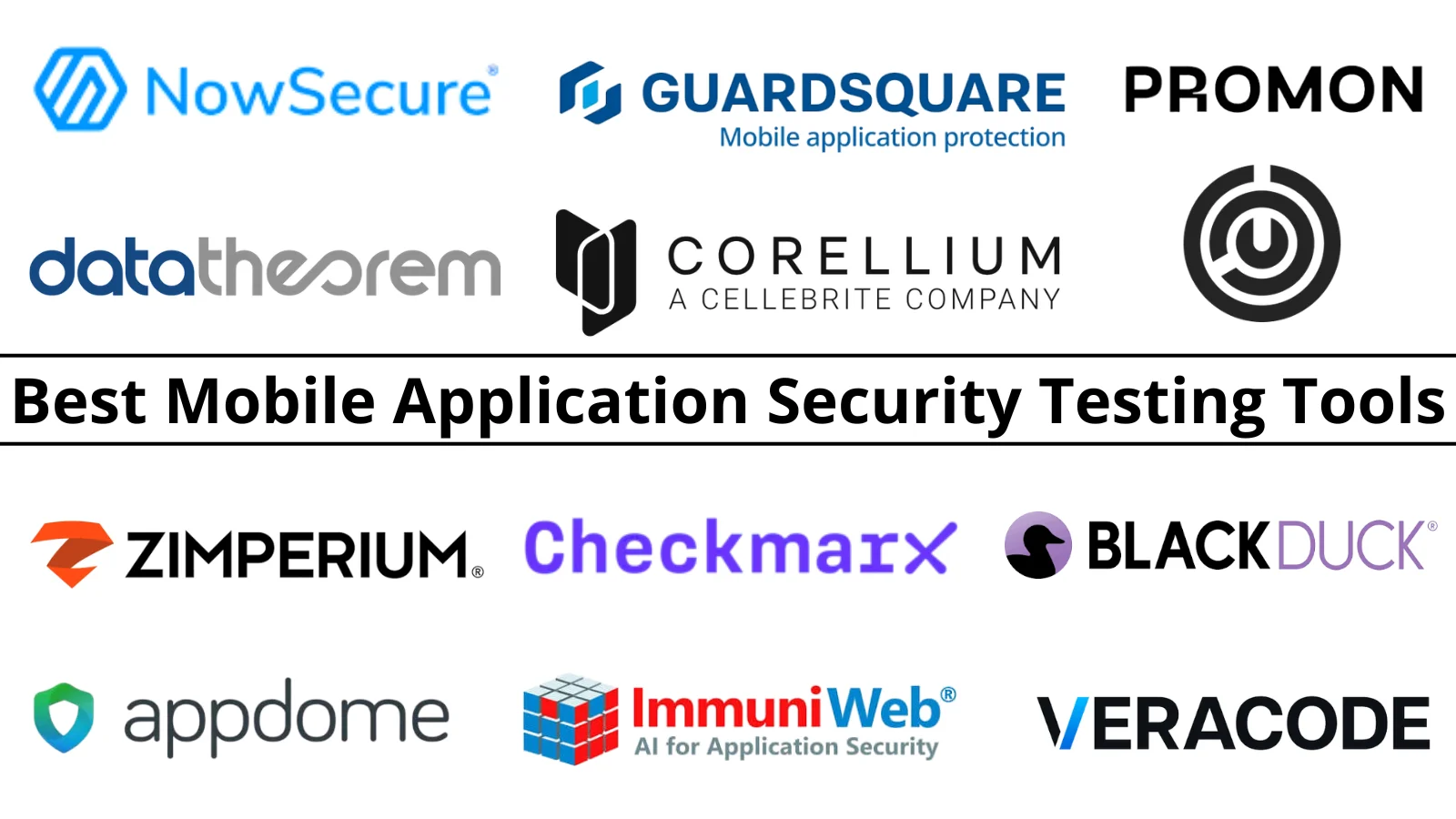
NowSecure and Data Theorem mobile security lead automated mobile testing, Guardsquare owns shielding/obfuscation, and Corellium’s virtual devices changed what deep mobile research costs.
Twelve options across testing, shielding, virtualization, and runtime lanes mapped to MASVS so the acronyms mean something.
Quick Verdict: Best Mobile AppSec at a Glance
• Best automated testing: NowSecure (pipeline MAST) | Data Theorem (API-aware continuous)
• Best shielding/obfuscation: Guardsquare (ProGuard/DexGuard/iXGuard) | Promon (SHIELD) | Appdome (no-code defense)
• Best research/virtualization: Corellium iOS/Android virtual devices
• Best researcher-lane scanner: Oversecured | Best runtime/MTD pairing: Zimperium
• Platform lanes: Veracode | Checkmarx | Black Duck | Pentest-plus: ImmuniWeb
| Product | Lane | Standout | Pricing structure | Editor’s rating* |
| NowSecure | Testing | Pipeline MAST + MASVS | Tiered/quote | 4.5/5 |
| Data Theorem | Testing | Mobile+API continuous | Quote | 4.4/5 |
| Guardsquare | Shielding | DexGuard/iXGuard depth | Tiered/quote | 4.5/5 |
| Corellium | Virtualization | Virtual iOS/Android | Published tiers | 4.5/5 |
| Zimperium | Runtime/MTD | zShield + zDefend | Quote | 4.3/5 |
| Promon | Shielding | SHIELD runtime protection | Quote | 4.3/5 |
| Appdome | No-code defense | Build-time fusion | Tiered/quote | 4.2/5 |
| Oversecured | Researcher scanner | Deep Android/iOS SAST | Published/per-scan | 4.2/5 |
| ImmuniWeb | Pentest-plus | AI-assisted mobile tests | Tiered | 4.0/5 |
| Veracode | Platform | Policy-governed MAST | Quote | 4.0/5 |
| Checkmarx | Platform | One-queue mobile SAST | Quote | 4.0/5 |
| Black Duck | Platform | Coverity-family mobile | Quote | 3.9/5 |
Editorial, research-based; no lab testing or paid placement.
How We Evaluated
Research-based: MASVS coverage, pipeline integration, shielding depth, device-access model, pricing transparency. No lab claims; no vendor influence. Priority: lane separation testing finds, shielding hardens, virtualization enables, runtime defends.
Organizations conducting complete assessments often reference the OWASP Mobile Application Penetration Testing Framework to align internal policies with broader industry standards.
The 12 Best Mobile AppSec Tools in 2026
1. NowSecure — Best Pipeline MAST

Best for: Automated testing on every build.
Real-device and automated analysis mapped to MASVS/MASA CI-native, store-compliance aware, the dedicated-testing anchor.
Teams deploying NowSecure mobile application security testing can continuously detect compliance gaps and binary flaws in both iOS and Android release pipelines.
Key features: Automated MAST; MASVS mapping; CI integration; store-compliance checks.
Pros: Dedicated depth; standards fluency.
Cons: Testing lane only.
Pricing: Tiered/quote.
Differentiator: MASVS verdicts at merge speed.
2. Data Theorem — Best Mobile + API Continuous

Best for: Apps whose risk lives in their backends.
Continuous mobile scanning fused with API discovery/testing the full attack path, not just the binary. Coupling mobile binary checks with dedicated API security providers ensures that external endpoints and cloud backends are audited simultaneously.
Key features: Mobile Secure; API Secure unity; continuous monitoring; SDK analysis.
Pros: API-path breadth.
Cons: Platform quote.
Pricing: Quote.
Differentiator: Tests the app and the APIs it calls.
3. Guardsquare — Best Shielding & Obfuscation

Best for: Hardening binaries against reverse engineering.
DexGuard/iXGuard obfuscation and RASP-style checks atop ProGuard heritage plus AppSweep’s free scanning floor. Implementing binary obfuscation prevents reverse-engineering via standard Android penetration testing tools and interactive decompilers.
Key features: Obfuscation; anti-tamper; environment checks; AppSweep free scanner.
Pros: Shielding depth; free floor entry.
Cons: Protection lane, not testing.
Pricing: Tiered/quote; AppSweep free.
Differentiator: The binary attackers can’t read.
4. Corellium — Best Virtual Devices

Best for: Deep research without device farms.
Virtualized iOS/Android with root/jailbreak-level access, snapshots, and automation security research’s infrastructure shift, published pricing.
Utilizing ARM-native virtual devices streamlines mobile security testing alongside dynamic instrumentation frameworks like Frida security tooling.
Key features: Virtual iOS/Android; kernel access; snapshots; MATRIX automation.
Pros: Research superpowers; pricing clarity.
Cons: Platform lane, not turnkey scanning.
Pricing: Published tiers.
Differentiator: The jailbroken iPhone that’s a browser tab.
5. Zimperium — Best Runtime + MTD Pairing

Best for: In-app defense with device-threat context.
zShield hardening and zDefend in-app runtime protection beside the MTD estate mobile defense across both hats. Pairing in-app defense with mobile threat protection strategies prevents rogue apps from hooking sensitive memory spaces on compromised devices.
Key features: App shielding; in-app RASP; MTD signals; key protection.
Pros: Runtime + threat-intel pairing.
Cons: Quote-based.
Pricing: Quote.
Differentiator: The app that knows its device is hostile.
6. Promon — Best App Shielding Purity

Best for: Banking-grade in-app protection.
SHIELD’s runtime defense anti-tamper, anti-hooking, secure keyboard inside apps facing hostile devices. Enforcing runtime app self-protection prevents credential theft and screen-scraping during active mobile malware infections.
Key features: Runtime shielding; anti-hooking; secure UI; SDK delivery.
Pros: Financial-sector pedigree.
Cons: Shielding lane; quotes.
Pricing: Quote.
Differentiator: The banking app that fights back.
7. Appdome — Best No-Code Defense

Best for: Fusing protections without SDK work.
Build-time defense fusion shielding, anti-fraud, MTD integrations configured, not coded. Automating security injection into compiled binaries simplifies compliance across DevSecOps pipelines without requiring manual developer re-architecture.
Key features: No-code fusion; protection catalog; build integration; monitoring.
Pros: Speed; breadth.
Cons: Config-model fit; tiers.
Pricing: Tiered/quote.
Differentiator: Protection as a build step.
8. Oversecured — Best Researcher-Lane Scanner

Best for: Deep Android/iOS vulnerability scanning per-app.
The researcher-built scanner catching IPC, deep-link, and platform-specific flaws others miss published per-scan/subscription pricing.
Running deep static analysis highlights severe security risks, including unauthenticated IPC access and mobile application zero-day flaws.
Key features: Deep platform rules; per-scan model; researcher pedigree.
Pros: Finding quality; pricing clarity.
Cons: Point-tool scope.
Pricing: Published per-scan/tiers.
Differentiator: The scanner bug-bounty hunters respect.
9. ImmuniWeb — Best Pentest-Plus

Best for: Mobile tests with human-verified findings.
AI-assisted testing with pentest packaging and compliance mapping. Combining automated scanning with verified human assessment mirrors the results of comprehensive penetration testing services.
Key features: Mobile suite; verified findings; compliance reports.
Pros: Verified output.
Cons: Depth vs dedicated lanes.
Pricing: Tiered.
Differentiator: The scan that reads like a pentest.
10. Veracode — Best Policy-Governed Platform

Best for: Regulated programs adding mobile to the plane.
Mobile static/behavioral lanes under the attestation umbrella. Integrating mobile analysis into enterprise static application security testing (SAST) suites provides centralized policy oversight across web, desktop, and mobile codebases.
Key features: Platform MAST; policy; unified reporting.
Pros: Governance unity.
Cons: Mobile-depth contests.
Pricing: Quote.
Differentiator: Mobile in the compliance story.
11. Checkmarx — Best One-Queue Mobile SAST

Best for: Checkmarx One estates scanning mobile code.
Mobile-aware SAST in the platform queue. Consolidating mobile scanning within broader application security testing checklists ensures developers maintain consistent code-quality standards.
Key features: Mobile SAST; platform unity; policy.
Pros: Queue coherence.
Cons: Binary/runtime lanes elsewhere.
Pricing: Quote.
Differentiator: Mobile code beside everything else.
12. Black Duck — Platform Mobile Lane

Best for: Black Duck estates covering mobile code/deps.
Coverity-family analysis and SCA applied to mobile projects. Scanning open-source libraries embedded in mobile packages ensures compliance with software composition analysis standards.
Key features: SAST/SCA on mobile; platform reporting.
Pros: Estate continuity.
Cons: Dedicated-mobile depth.
Pricing: Quote.
Differentiator: The suite’s mobile chapter.
Full Comparison Table
| Product | Lane | MASVS/testing | Shielding | Pricing |
| NowSecure | Testing | Core | — | Tiered |
| Data Theorem | Testing+API | Yes | — | Quote |
| Guardsquare | Shielding | AppSweep free | Core | Tiered |
| Corellium | Virtualization | Enables | — | Published |
| Zimperium | Runtime | — | Yes | Quote |
| Promon | Shielding | — | Core | Quote |
| Appdome | No-code | — | Fusion | Tiered |
| Oversecured | Scanner | Deep | — | Published |
| ImmuniWeb | Pentest+ | Yes | — | Tiered |
| Veracode | Platform | Yes | — | Quote |
| Checkmarx | Platform | Code | — | Quote |
| Black Duck | Platform | Code | — | Quote |
How to Choose
Test and shield are different budgets: MAST (NowSecure/Data Theorem/Oversecured) finds; shielding (Guardsquare/Promon/Appdome/Zimperium) hardens against hostile devices regulated consumer apps usually need both.
Give researchers Corellium-class devices it changes what internal teams can do.
Platforms cover code lanes if you’re already committed.
Common mistakes: shipping unshielded banking apps; testing binaries but never backends (Data Theorem’s point); confusing MTD with app shielding; treating store review as security review.
Evaluating runtime threats alongside dynamic application security testing (DAST) guarantees full coverage across all application execution layers.
FAQ: Best Mobile AppSec Testing
What is the best mobile application security testing tool in 2026?
NowSecure and Data Theorem for automated testing, Guardsquare/Promon/Appdome for shielding, Corellium for research-grade virtual devices, Oversecured for deep per-app scanning, Zimperium for runtime-plus-MTD.
How is mobile AppSec priced?
Testing platforms tier/quote; Oversecured publishes per-scan; Corellium publishes device tiers; shielding quotes by app/volume. Testing and protection are separate budget lines.
Testing vs shielding — do we need both?
Usually for consumer and financial applications: testing identifies and removes flaws during development, while shielding raises the technical cost for attackers operating on hostile devices. The OWASP mobile security checklist and MASVS-R framework explicitly delineate requirements for the resilience lane.
What makes Corellium different?
Virtualized iOS and Android environments with kernel-level access allow security teams to replace physical device farms and jailbreak hunting with instant snapshots and automated testing workflows. Coupling virtual labs with Android security penetration testing tools significantly accelerates dynamic research.
Do the big AppSec platforms cover mobile adequately?
For code and dependencies, credibly; for binary behavior, resilience, and store-runtime realities, dedicated mobile lanes still lead which is why this category persists.
Conclusion
NowSecure/Data Theorem anchor testing, Guardsquare anchors shielding, and Corellium rewrote research economics test every build, shield what faces hostile devices, and map it all to MASVS.
Engaging experienced penetration testing services provides independent validation of both build-time controls and runtime resilience.
Next step: run a MASVS-L2 gap assessment on your flagship app; the lanes you’re missing will name themselves.
Trust Block
About the author: [AUTHOR NAME], [credential]. Reviewed by: [REVIEWER NAME]. Last updated: September 2026.
Disclosure: GBHackers editorial is independent; vendors do not pay for inclusion or ranking.
More on GBHackers:
• Best Mobile Threat Defense, Compared and Priced
• Best SAST Tools, Compared and Priced
• Best DAST Tools, Compared and Priced
• Best API Security Tools, Compared and Priced
• Best Bug Bounty Platforms, Compared and Priced
• Best Penetration Testing Companies
• Best Fuzzing Tools, Compared and Priced
• Best SCA Tools, Compared and Priced
• Best Fraud Prevention Platforms
• Best Client-Side Security, Compared and Priced
• Best DevSecOps Tools