

A sophisticated campaign by the actor tracked as “Dropping Elephant” that uses a China-themed decoy document and a heavily reworked, in-memory remote access trojan (RAT).
The intrusion chain combines classic living-off-the-land techniques with modern in-memory execution: an LNK shortcut spawns an obfuscated PowerShell downloader, which stages artifacts in C:\Users\Public, then leverages DLL side‑loading.
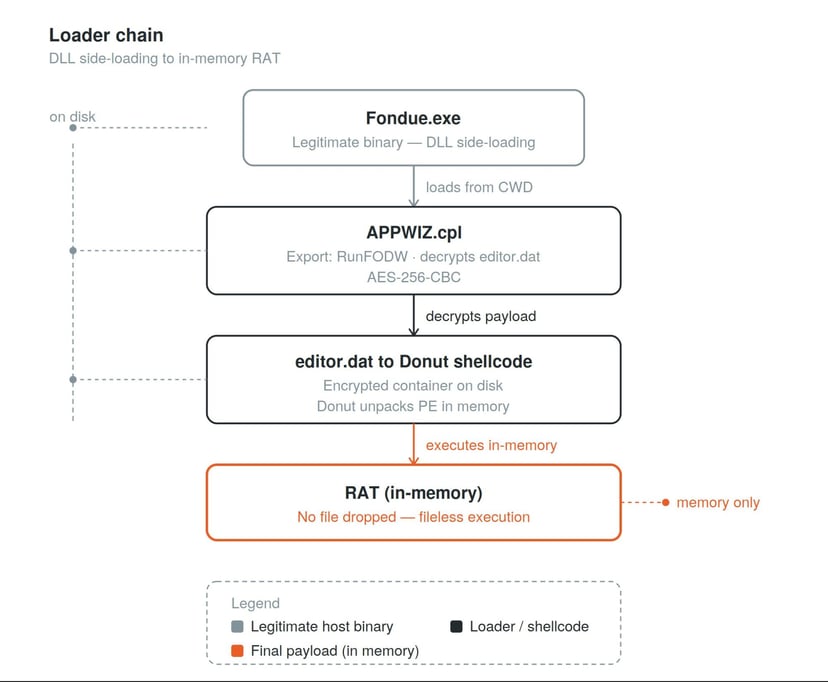
A legitimate Microsoft binary (Fondue.exe) to bootstrap a loader that decrypts and executes a Donut shellcode blob that maps the final RAT directly into memory. The result is a low-footprint implant designed to evade disk-oriented detection and complicate static analysis.
The initial lure is a GRES-3 contract completion document that serves as a believable energy-sector decoy while a background downloader retrieves multiple files from chinagreenenergy[.]org.
Attackers deliberately employ junk file extensions and renaming to reconstruct Fondue.exe, APPWIZ.cpl, and runtime libraries in the public profile.
Persistence is achieved by a scheduled task, GoogleErrorReport, configured to run every minute and to execute Fondue.exe which is then coerced into loading the malicious APPWIZ.cpl from the nonstandard location C:\Users\Public, a key behavioral indicator defenders can monitor.
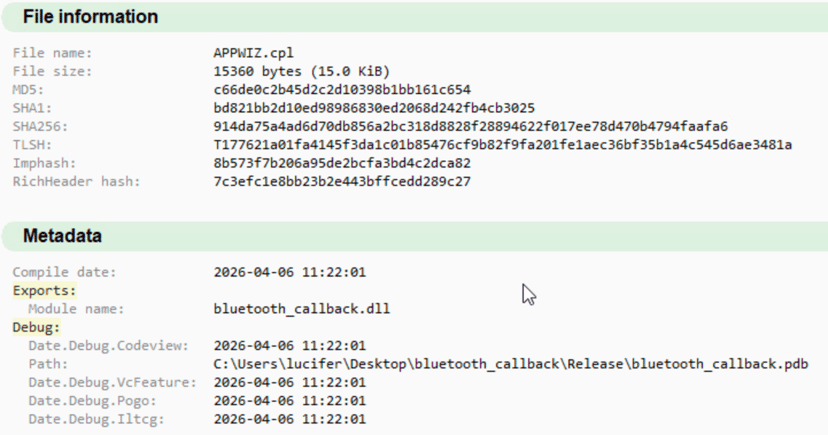
APPWIZ.cpl functions as the on-disk loader: it Base64-decodes an AES-256-CBC ciphertext stored as editor.dat in C:\Windows\Tasks, assembles the key and IV on the stack, and decrypts a Donut shellcode payload.
Rapid7 said in a report shared with GBhackers, identified a sophisticated malware campaign attributed to the threat actor “Dropping Elephant,” characterized by the use of a China-themed decoy document.
Donut then maps the embedded 32-bit native RAT into RWX memory, resolves imports, applies relocations, and transfers execution without dropping the implant to disk.
Before handing control to the RAT, Donut actively patches AMSI, WLDP, and ETW hooks in-process, significantly reducing the visibility provided by common telemetry mechanisms.
China-Themed Loader Chain
The final RAT demonstrates multiple hardening and anti-analysis measures: control-flow flattening, runtime API reconstruction via LoadLibrary/GetProcAddress loops, static CRT linking, opaque predicates, process and VM artifact checks, CPUID hypervisor probes, and public-IP geolocation gating.
Network communications have been hardened as well beaconing occurs over HTTPS to gcl-power[.]org using a Salsa20-encrypted payload envelope and a 23-character token.
During reconnaissance the implant assembles a comprehensive host fingerprint including username, computer name, public IP and country, OS version, bot ID, and a full running-process list; these fields are wrapped as base64url(Salsa20(base64url(value))).
Operator capabilities observed include directory listing, remote download-and-execute, screenshot capture with WIC encoding, shell command execution, and file upload.
Despite substantial code rework, Rapid7’s analysis links the sample to Dropping Elephant through shared beaconing patterns, screenshot logic, WININET request flow, repeated buffer constants, and overlapping command-handler structures identified by AST-level comparison with a July 2025 reference sample.
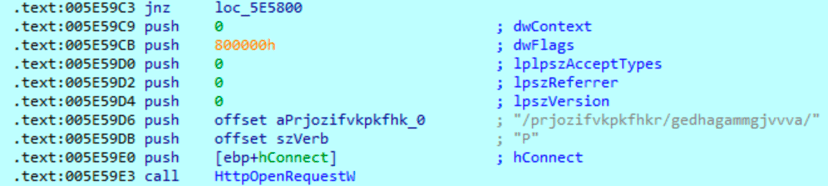
The RAT periodically sends HTTPS POST requests to the C2 server on port 443 (INTERNET_FLAG_SECURE). It uses a 23-character token, RRn926EmIRfm9IlJyP1yVO2 for C2 traffic to gcl-power[.]org.
BinDiff similarity was low due to control-flow flattening, but Diaphora revealed function-level overlaps consistent with lineage. This evolution reflects an emphasis on in-memory execution and telemetry evasion while retaining operational patterns familiar to the group.
Defenders should focus on behavioral detection rather than IOCs alone: watch for LNK files spawning obfuscated PowerShell, staged files in C:\Users\Public, scheduled tasks named GoogleErrorReport executing at high frequency, and instances of Fondue.exe loading APPWIZ.cpl from nonstandard paths.
Ensure endpoint tooling can surface memory-resident payloads and detect tampering of AMSI, WLDP, and ETW.
Indicators of compromise (IOCs)
| SHA-256 | File | Comment |
| a8ecbd9c049044ca4990a0e5960d19ce782a3b42d7763e9693d7c91ead24a0b7 | GRES3001.lnk | Initial-access shortcut; launches conhost.exe → PowerShell downloader |
| 56d656d684077e7b3231393f5464447cdc8eea81b6415c5f010bc52f0c8cb317 | GRES3001.pdf | Decoy lure document |
| b58351ead08db413ca499cfeb1b1091ed8bfd68f4089605e452fa01ed46f42b1 | Fondue.exe | Legitimate Microsoft side-loading host |
| 914da75a4ad6d70db856a2bc318d8828f28894622f017ee78d470b4794faafa6 | APPWIZ.cpl | Malicious side-loaded loader; exports RunFODW |
| 718812adb0d669eea9606432202371e358c7de6cdeafeddad222c36ae0d3f263 | msvcp140.dll | Bundled VC++ runtime; verify against known-good |
| 09d1e604e8cdd06176fcc3d3698861be20638a4391f9f2d9e23f868c1576ca94 | vcruntime140.dll | Bundled VC++ runtime; verify against known-good |
| a5e448af73b0ff6b6fcfe6ef7808120e1fd7e5c4c9b4edd68e1c980e5ea3406b | editor.dat | Base64-wrapped AES-256-CBC encrypted payload file |
| ecab0e747bff16a1163bbd9bb494e68dd4d7ca655ac7279bd4dd73221f7df57c | editor.decrypted.bin | AES-decrypted Donut loader blob |
| 7099c33933716c00c1f4bdb0281c230b981c76b23d7d1c83abc6f58968267d54 | editor.extracted.exe | Final RAT, carved from memory |
Note: IP addresses and domains are intentionally defanged (e.g., [.]) to prevent accidental resolution or hyperlinking. Re-fang only within controlled threat intelligence platforms such as MISP, VirusTotal, or your SIEM.
Follow us on Google News, LinkedIn, and X to Get Instant Updates and Set GBH as a Preferred Source in Google.


.)