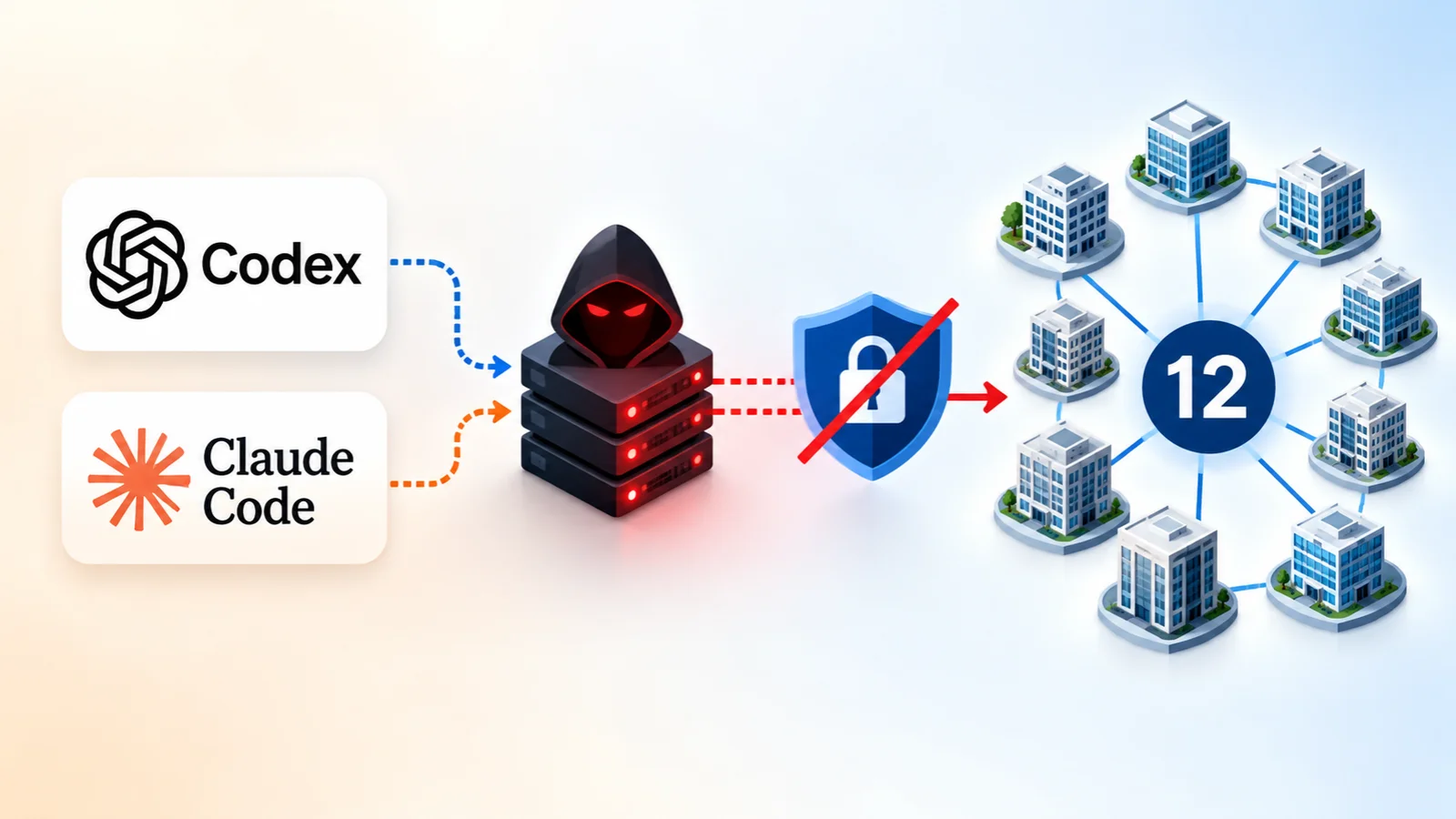

Symantec’s Threat Hunter Team has found an unauthorized relay service that installs the genuine OpenAI Codex and Anthropic Claude Code CLIs, then rewrites their settings to turn off sandboxing.
It has affected 12 organizations since early 2026, mostly in mainland China.
Codex Claude Code relays
AI coding agents read files, write code, and run commands on the host. A sandbox limits what they can do. The relay does not ship a trojanized client. Users first run a legitimate npm install of Codex or Claude Code.
A fileless PowerShell or bash one-liner (iwr | iex or curl | bash) then runs, fetched from lookalike domains such as vibe.aiok[.]me.
According to technical research published by Symantec, the script rewrites ~/.codex/config.toml or ~/.claude/settings.json.
It points base_url or ANTHROPIC_BASE_URL at relay-controlled servers and swaps in relay-issued API keys. It saves both as user-scope environment variables so they survive a reboot.
It also sets sandbox_mode = “danger-full-access”, enables network access for the write sandbox, and disables telemetry and error reporting.
On one host, it ran claude /logout, deleted the Anthropic authentication variables, and forced a fresh login. Several hosts also queried the Windows geo setting, likely to confirm the system was in the region the relay serves.
This is not a vulnerability in Codex or Claude Code. The tools behave as designed once their configuration is changed.
Victims include industrial automation, semiconductors, pharmaceuticals, shipping, tire manufacturing, petrochemicals, and data center services.
Some are Chinese operations of firms based in South Korea, Taiwan, and Malaysia. Most look like employees who wanted a Western AI assistant that isn’t sold in their market, not chosen targets.
Symantec found no evidence that the operator is abusing its position. The risks are potential, rather than observed. The relay sees every prompt, file, and secret sent to the agent. It can alter or fabricate responses, and with the sandbox off and network access on, a malicious response could run with the user’s full privileges.
Furthermore, the Claude keys use the sk-ant-oat01- prefix, which Anthropic uses for subscription OAuth tokens, consistent with pooled flat-rate subscriptions being resold. Because the credentials sit in user-scope environment variables, other tools on the same machine can read them.
The observed configuration tampering reflects growing operational concerns surrounding AI coding assistants deployed across unvetted corporate endpoints.
Defenders should watch endpoints running these CLIs for changes to base_url or ANTHROPIC_BASE_URL, the presence of danger-full-access in config.toml, and instances of OPENAI_BASE_URL, CODEX_API_KEY, or ANTHROPIC_AUTH_TOKEN set outside approved deployment.
Security teams must also monitor for an iwr | iex or curl | bash run right after npm install -g @openai/codex or @anthropic-ai/claude-code, alert on CLI traffic directed to destinations outside an approved AI allow-list, and actively guard against rogue supply chain attacks.


