

A critical SSRF vulnerability has been detected recently in the VMware Workspace ONE UEM console, that could be exploited by the threat actors to steal sensitive data and information.
For over-the-air remote management of the following devices is done via Workspace ONE Unified Endpoint Management since it’s a VMware solution:-
- Desktops
- Mobile
- Rugged
- Wearables
- IoT devices
The cybersecurity experts have tracked this critical SSRF (Server-side Request Forgery) vulnerability as CVE-2021-22054 that has achieved a severity score of 9.1, in short, it’s marked as critical severity.
Flaw profile
- CVE ID: CVE-2021-22054
- Description: It’s a Server Side Request Forgery (SSRF) vulnerability in VMware Workspace ONE UEM console.
- Advisory ID: VMSA-2021-0029
- Severity: Critical
- CVSS: 9.1
- Issue Date: 2021-12-16
Exploitation
Without user interaction, this critical vulnerability can be easily exploited by an unauthenticated attacker remotely, and this makes this flaw more critical and less complex.
That’s why here, all the users and administrators were strongly recommended by CISA to immediately apply the necessary mitigation and review VMware Security Advisory VMSA-2021-0029.
Affected and Fixed versions
In the below table we have mentioned all the affected and fixed versions of VMware Workspace ONE UEM:-
| Impacted Version | Fixed Version |
| 2109 | Workspace ONE UEM patch 21.9.0.13 and above |
| 2105 | Workspace ONE UEM patch 21.5.0.37 and above |
| 2102 | Workspace ONE UEM patch 21.2.0.27 and above |
| 2101 | Workspace ONE UEM patch 21.1.0.27 and above |
| 2011 | Workspace ONE UEM patch 20.11.0.40 and above |
| 2010 | Workspace ONE UEM patch 20.10.0.23 and above |
| 2008 | Workspace ONE UEM patch 20.8.0.36 and above |
| 2007 | Workspace ONE UEM patch 20.7.0.17 and above |
Workarounds
In case if you fail to apply the available patch or update then, in that case, to block exploitation attempts the security analysts have recommended short-term mitigation.
For short-term mitigation or workarounds, you have to follow the steps that we have mentioned below:-
- First of all, you have to recognize all the Windows servers with UEM Console application installed in the environment.
- Then using Remote Desktop or Physical access you have to get admin-level access to the server.
- Now using your favorite text editor patch the Workspace ONE UEM web.config file. By default, this file is located in the {Install-Drive}\AirWatch\Default Website folder.
- Add the following rewrite rule to the rules key (xpath: /configuration/system.webServer/rewrite/rules)
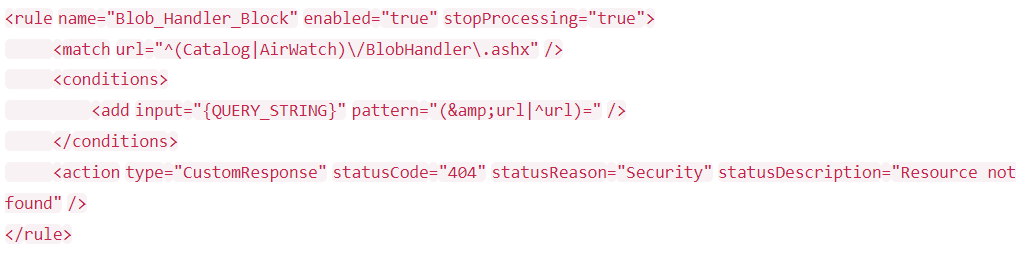
- Once done, now restart IIS after saving the above changes, that’s it.
Moreover, here’s what VMware stated:-
IIS reset will cause logged-in administrators to the server instance being patched to log out. Administrators should be able to log back in shortly after.”
You can follow us on Linkedin, Twitter, Facebook for daily Cybersecurity and hacking news updates.






