Sunday, October 18, 2026

Beware of Fake Indian Rewards Apps That Installs Malware on Your Devices

Microsoft 365 Defender Research Team analysed the new version of previously reported info-stealing Android malware, delivered through an SMS campaign. This new version has remote access trojan (RAT) capabilities, targeting the customers of Indian banks.

The Message contains links that points to the info-stealing Android malware, leading the user to download a fake banking rewards app.

The SMS Campaign Attack Flow

Researchers say, the fake app, detected as [TrojanSpy:AndroidOS/Banker.O], used a different bank name and logo compared to a similar malware reported in 2021.

“The malware’s RAT capabilities allow the attacker to intercept important device notifications such as incoming messages, an apparent effort to catch two-factor authentication (2FA) messages often used by banking and financial institutions”, Microsoft
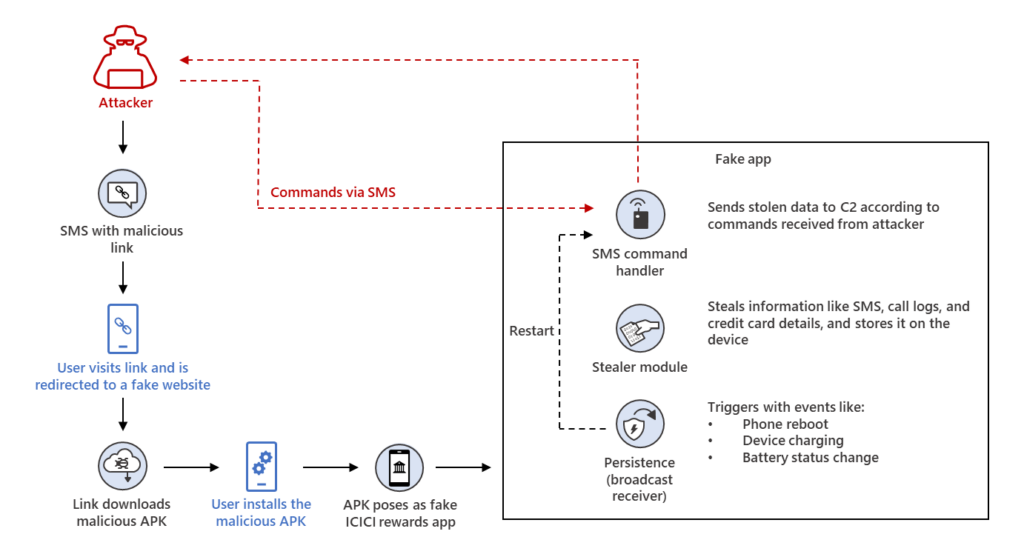
This diagram illustrates the typical infection chain of this Android malware. The infection starts from an SMS message that contains a malicious link that leads to the malicious APK.
SMS Campaign Attack Flow

The command and control (C2) server is linked to 75 different malicious APKs, all of which are based on open-source intelligence. 

The research team identified many other campaigns targeting Indian bank customers, including:

  • Axisbank_rewards[.]apk
  • Icici_points[.]apk
  • Icici_rewards[.]apk
  • SBI_rewards[.]apk

While researching on icici_rewards[.]apk, it presents itself as ICICI Rewards. Initially, this SMS campaign sends messages that contain a malicious link, leading to install malicious APK on a target’s mobile device.

“To lure users into accessing the link, the SMS claims that the user is being notified to claim a reward from a known Indian bank”, Microsoft Researchers.
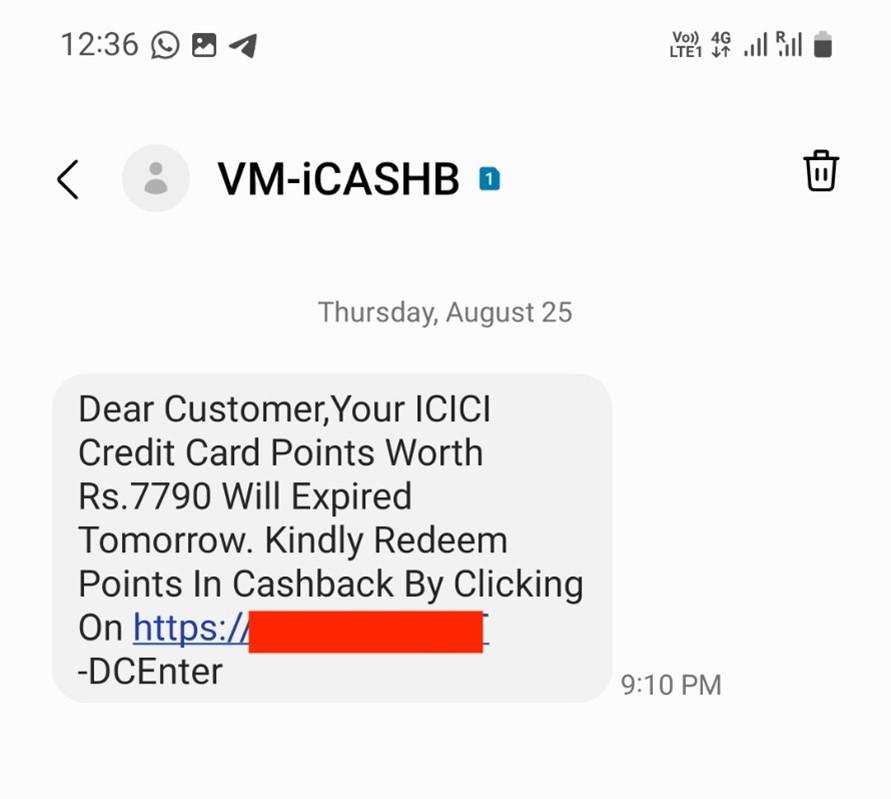
Screenshot of the SMS message received. The message contains a link and mentions the name of a legitimate India-based bank.

Upon user interaction, it displays a splash screen with the bank logo and proceeds to ask the user to enable specific permissions for the app.
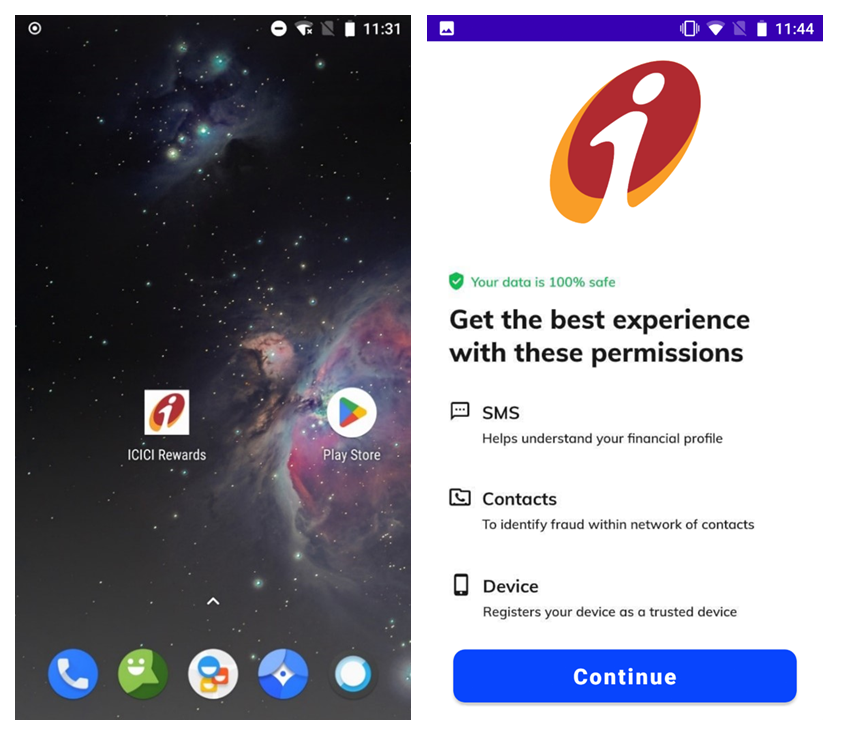
Screenshots of the fake app installed on the mobile device and where it states the Android permissions it needs to be enabled. The app uses an India-based bank's logo to appear legitimate.App installed on the Android device, Asks users to enable permissions on text messaging and contacts

It also requests users to enter their credit/debit card information as part of a supposed sign-in process, while the trojan waits for further instructions from the attacker.

These commands let the malware to collect system metadata, call logs, intercept phone calls, and steal credentials for email accounts such as Gmail, Outlook, and Yahoo.

“This malware’s new version adds several RAT capabilities that expands its information stealing. It enables the malware to add call log uploading, SMS message and calls interception, and card blocking checks”, Microsoft

Mitigation

  • Download and install applications only from official app stores.
  • Android device users can keep the Unknown sources option disabled to stop app installation from unknown sources.
  • Use mobile solutions such as Microsoft Defender for Endpoint on Android to detect malicious applications.

Download Free SWG – Secure Web Filtering – E-book

Gurubaran
Gurubaran
Gurubaran is a co-founder of Cyber Security News and GBHackers On Security. He has 10+ years of experience as a Security Consultant, Editor, and Analyst in cybersecurity, technology, and communications.

Hot this week

How To Access Dark Web Anonymously and know its Secretive and Mysterious Activities

What is Deep Web The deep web, invisible web, or...

How to Build and Run a Security Operations Center (SOC Guide) – 2023

Today’s Cyber security operations center (CSOC) should have everything...

Russian Hackers Bypass EDR to Deliver a Weaponized TeamViewer Component

TeamViewer's popularity and remote access capabilities make it an...

Web Server Penetration Testing Checklist – 2026

Web server pentesting is performed under three significant categories: identity,...

ATM Penetration Testing – Advanced Testing Methods to Find The Vulnerabilities

ATM Penetration testing, Hackers have found different approaches to...

Hackers Use ConnectWise SkyKick Credentials to Access Microsoft 365, Halting Cloud Backups

Attackers abused compromised ConnectWise Cloud Backup credentials to access...

Anthropic’s Claude AI Uncovers Origins of NSA-Provided Cryptographic Keys After 25 Years

Anthropic says an internal Claude research model reconstructed how...

OpenBSD Kernel Flaw Dating Back 37 Years Enables Local Privilege Escalation to Root

A newly disclosed OpenBSD kernel exploitation chain combines a...

GhostAction Hackers Hide Credential-Stealing Malware in Fake Font Files Across 94 GitHub Repositories

GhostAction attackers have expanded their GitHub credential theft campaign...

SideCopy Hackers Target Indian Organizations With ReverseRAT Malware to Steal Data

Indian authorities have warned that SideCopy hackers are targeting...

New GhostBat Android Malware Targets 60 Banking and UPI Apps to Steal PINs

A new GhostBat RAT variant targets 60 Android financial...

New ROMULUS Malware Platform Uses Six Servers to Deliver Multiple Malicious Payloads

ROMULUS, a shared ClickFix delivery platform operating across six...

Related Articles

Recent News


