

A new Android malware campaign is masquerading as a “Banking KYC” verification app and spreading via WhatsApp messages to target banking users in India.
The malware is delivered as an APK shared over WhatsApp, posing as an urgent bank KYC or account verification update similar to previously reported Indian banking fraud campaigns.
Victims are told that their bank account may be blocked unless they install the attached “Banking KYC” app and complete verification, mirroring real-world fraud patterns where fake KYC alerts are pushed via messaging platforms.
Once installed, the app opens with a full-screen “Update Required” prompt containing a single “Install Update” button, creating the illusion of a mandatory in-app update rather than a fresh malware installation.
According to the report, the operation abuses fake KYC urgency, a multi-stage dropper, and native code obfuscation to silently deploy a secondary payload that can intercept SMS, control calls, run USSD codes, and harvest highly sensitive financial data.
Clicking “Install Update” triggers a sequence of prompts: the app first requests to create a VPN connection, then asks for permission to install unknown apps so it can silently deploy a hidden secondary APK.
The secondary payload does not appear in the launcher, so users see no new icon while the malware continues to run in the background with extended capabilities.
Multi-Stage Dropper and Native Obfuscation
The primary app, packaged as com.***appad.andr, acts as a loader rather than the main infostealer.
A non-exported receiver, InstallReceiver, that listens for installation events such as PACKAGE_ADDED and a custom install status action.
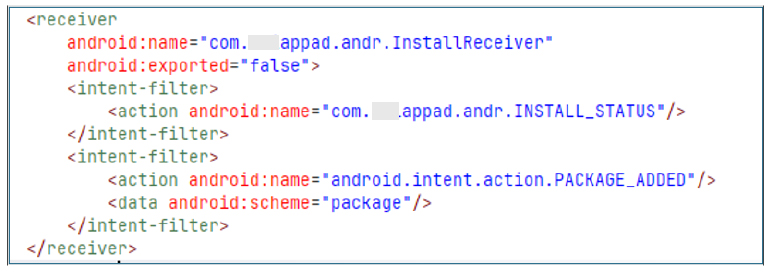
It embeds an encrypted APK asset, derives a 32‑byte XOR key from its own package name, and decrypts the payload at runtime before writing it to a temporary, obfuscated filename inside its private storage.
A session-based PackageInstaller flow then installs the decrypted payload (com.am5maw3.android) silently, using a controlled session and pending intent to minimize user interaction and bypass typical install friction on newer Android versions.
Static analysis shows that critical configuration values are moved out of the Java/Kotlin layer and into a native library, libnative-lib. so.
The native code exposes functions that return the C2 URL, encryption key, and agent identifier at runtime, assembling the primary backend endpoint as https[:]//jsonapi[.]biz and the hardcoded agent ID XGEKKWB3 character by character.
This design significantly complicates static analysis, as strings are not visible in decompiled Java, and key logic is hidden behind JNI calls into the native .so module.
The malware registers a custom SecureVpnService that configures a full-tunnel VPN with a local address (10.0.0.2) and Google DNS (8.8.8.8), forcing all device traffic through an application-controlled interface.
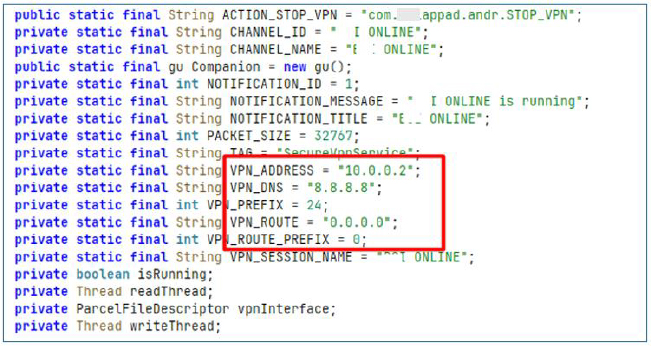
A continuous packet-processing loop turns this tunnel into a live surveillance and manipulation layer, allowing the malware to inspect, filter, or disrupt outbound connections, including telemetry to security services and cloud-based protections.
This network hijacking can degrade Google Play Protect and other reputation services, helping the malware and its C2 traffic evade detection.
Incoming FCM messages are routed to AgentCore.ProcessCommand, which supports operations such as SET_SMS_FORWARD, GET_SMS_LOGS, MAKE_CALL, RUN_USSD, SEND_SMS, and SYNC_STATUS, effectively turning the infected device into a remotely controlled fraud platform.
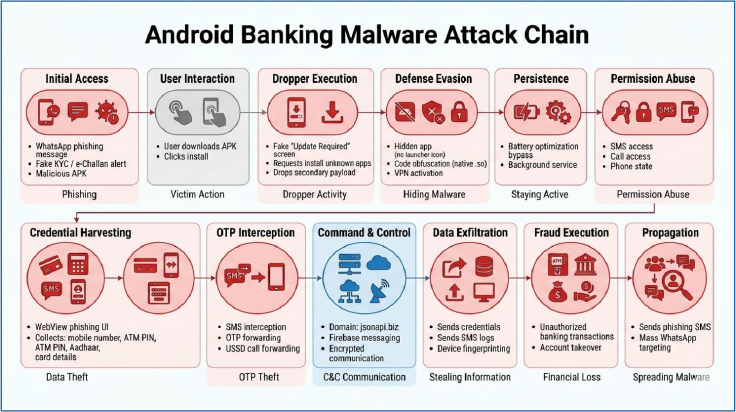
For command-and-control, the secondary payload integrates Firebase Cloud Messaging and registers AgentService as a handler for com.google.firebase.MESSAGING_EVENT.
The malware also requests WAKE_LOCK and battery optimization exemption so it can maintain long-lived background execution and continue communicating with the C2 even when the dropper is closed or removed.
SMS, Telephony Abuse and Data Exfiltration
Once permissions are granted, the secondary payload abuses telephony and SMS APIs to gain deep control over communications.
The filename uses Unicode-based obfuscation (ṩỹṧ꙱ṫḗṃ.tmp), likely intended to reduce visibility during static inspection or manual analysis.
A high-priority SMS receiver intercepts incoming messages, reconstructs PDUs, extracts sender and body, and forwards the content in real time to a remote number and to the backend via encrypted logs, enabling OTP interception and account takeover.
The malware can also bulk-dump the SMS inbox via content://sms/inbox, initiate outbound calls through TelecomManager.placeCall(), and send USSD codes to turn on or off call forwarding or query network status.
All runtime events and stolen data are wrapped into JSON structures containing device_id, log_type, content, and timestamps, then encrypted locally before being sent via HTTP POST to jsonapi[.]biz.
The base URL and encryption key are only exposed by native functions, and the key itself follows a simple repeated hexadecimal pattern, indicating lightweight obfuscation rather than strong cryptography.
This backend appears to be part of a broader, modular infrastructure designed for device registration, log ingestion, and fraud tasking.
On the user-facing side, the malware loads a statically bundled Next.js frontend inside a Capacitor WebView to present a highly polished phishing flow. The interface mimics a banking KYC journey and systematically collects:
- Mobile number and ATM PIN under “Account Verification”.
- Aadhaar number and date of birth as identity validation.
- Full card details (number, expiry, CVV, and PIN) under “Card Verification”.
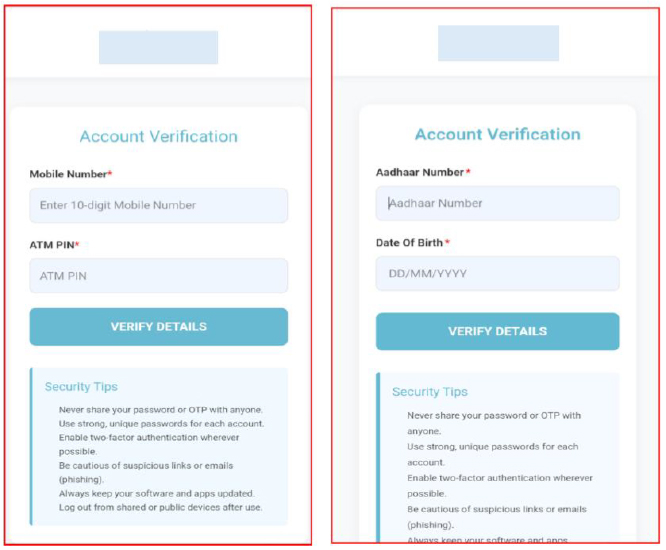
A final “verification in progress” screen reassures victims and instructs them to wait 24 hours, buying the attacker time to execute fraudulent transactions.
Strings and UI artifacts in the embedded frontend include “eChallan” references, closely aligning this campaign with earlier “RTO e-Challan” Android fraud operations that used two-stage droppers, VPN-based traffic hijacking, and JSON-themed C2 domains such as jsonserv[.]xyz and jsonserv[.]biz.
The consistent infrastructure pattern (jsonserv → jsonserv[.]biz → jsonapi[.]biz), similar WhatsApp distribution methods, and near-identical fraud workflow strongly suggest that this Banking KYC malware is an evolution of the same financially motivated Android threat actor targeting Indian users at scale.
IOCs
| Indicator | Type | Remarks |
| 34479b18597f1a0deb5d55b8450bc21af1d1f638c4ceca1ee19e6f5ac89d6be2 | Sha256 | Dropper |
| 1d261b45e73b5b712becb12ed182ec89d3dd0d73143a2dd8ff5512da489a50eb | Sha256 | Dropped apk |
| Jsonapi[.]biz | Domain | C2 |
| jsonserv[.]biz | Domain | C2 |
| jsonserv[.]xyz | Domain | C2 |
Follow us on Google News, LinkedIn, and X to Get Instant Updates and Set GBH as a Preferred Source in Google.


