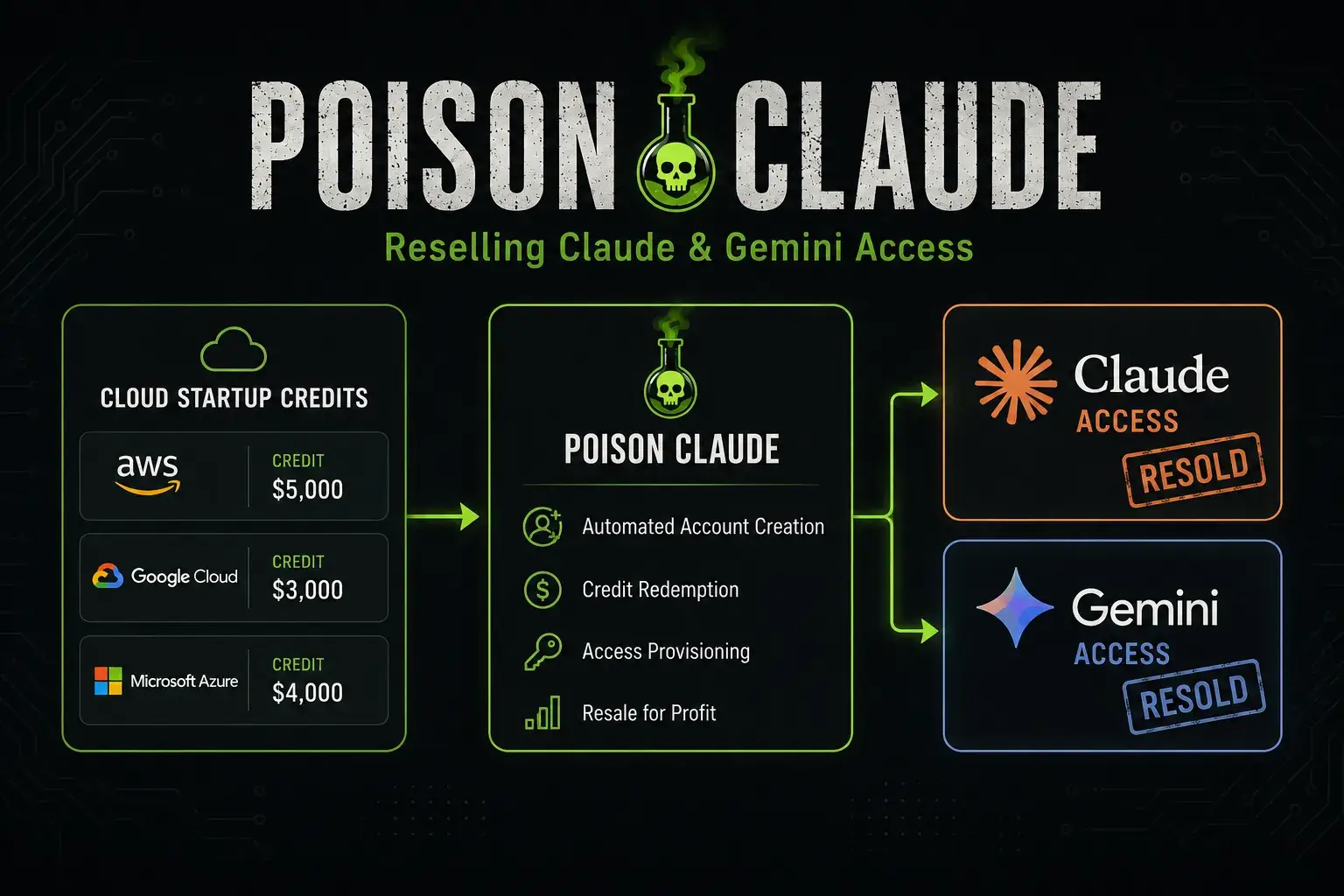

Threat actors are exploiting free cloud trials and startup credit programs to build gray-market AI proxy services. These services resell discounted access to advanced AI models, including Anthropic Claude and Google Gemini, according to Okta Threat Intelligence.
These services rely on fraudulent or synthetic account registrations to accumulate promotional credits offered by cloud providers. The operators pool these accounts behind a proxy API, enabling customers to access premium models at a fraction of the official price while concealing the original accounts and infrastructure used to process the requests.
Okta researchers identified several of these services advertised on underground forums, messaging platforms, and through GitHub-indexed proxy directories. These marketplaces appeal to customers seeking lower prices, access in unsupported regions, cryptocurrency payment options, and anonymity.
Hackers Abuse Cloud Startup Credits
One service, dubbed Poison Claude, advertised “unlimited” access to models through subscription packages based on prompt volume. Its operators claimed they could charge only 5% to 15% of standard per-token prices by routing customer requests through a pool of accounts funded by promotional cloud credits.
This service allegedly used AWS promotional credits for Amazon Bedrock, which hosts various third-party foundation models, including those from Anthropic. Customers received an Anthropic-compatible API key and were instructed to adjust environment variables so that Claude Code would send requests through the proxy instead of Anthropic’s official endpoint.

Okta discovered that an exposed status endpoint reported a total of 881 users, 872 of whom were active at the time of observation. While the main site was secured behind Cloudflare’s content delivery network, a related API endpoint exposed the hosting infrastructure running on a Hostinger server in Mumbai.
Another service, named Ecomagent, offered discounted access to Claude models, GPT Codex, and other AI tools through a custom API endpoint. Okta reviewed documentation containing response metadata suggesting the service used Google Vertex AI, which is now linked to Google’s Gemini Agent Enterprise Platform.
Google Cloud provides credits to new accounts and can offer qualifying AI startups substantial funding for Gemini-related services. Similarly, Anthropic offers startup credits ranging from $25,000 to $100,000.
Fraudulently acquiring or repurposing such credits for resale of access would violate providers’ terms and could put both operators and users at risk of account suspension or data security vulnerabilities.
Both services reportedly exposed unauthenticated API routes, showing subscriber counts below 1,000, indicating that even relatively small operations can profit from cloud credit abuse at scale.

Okta also observed numerous instances of automated registrations with an unnamed AI video provider that offers free trials. From June 2023 to July 2026, the company recorded over 105,000 suspected brute-force sign-up attempts originating from 251 IP addresses associated with bot activity.
This activity involved VPNs, proxy infrastructure, disposable email domains, and patterns suggestive of synthetic identity creation. Cybercriminal vendors also advertised accounts and API credentials for the affected platform and accepted cryptocurrency payments.
The gray-market model presents risks for both AI providers and customers. Proxy operators can access prompts and responses that pass through their infrastructure, potentially exposing proprietary code, credentials, research data, or sensitive business information. They may also substitute cheaper models, harvest user data, or suddenly lose access if upstream providers detect fraud.
Okta reported its findings to Cloudflare, Anthropic, AWS, and Google Cloud, highlighting the need for stronger measures against signup fraud, identity verification, disposable email screening, bot detection, and behavioral monitoring across AI and cloud service platforms.
Stop new phishing & malware before they compromise your business. Integrate live intel from 15K SOCs around the world