

Two closely related espionage campaigns targeting Cambodian government organizations that abuse a legitimate VMware-signed binary to sideload a custom loader dubbed NIGHTFORGE, which in turn deploys a Havoc Demon implant in memory.
TRU attributes both operations to a previously unreported cluster it calls Khmer Shadow, based on targeting, lure construction and shared infrastructure; the activity appears focused on defense and military intelligence collection in Southeast Asia.
Both campaigns used meeting- or cooperation-themed self-extracting (SFX) archives delivered likely via spear-phishing.
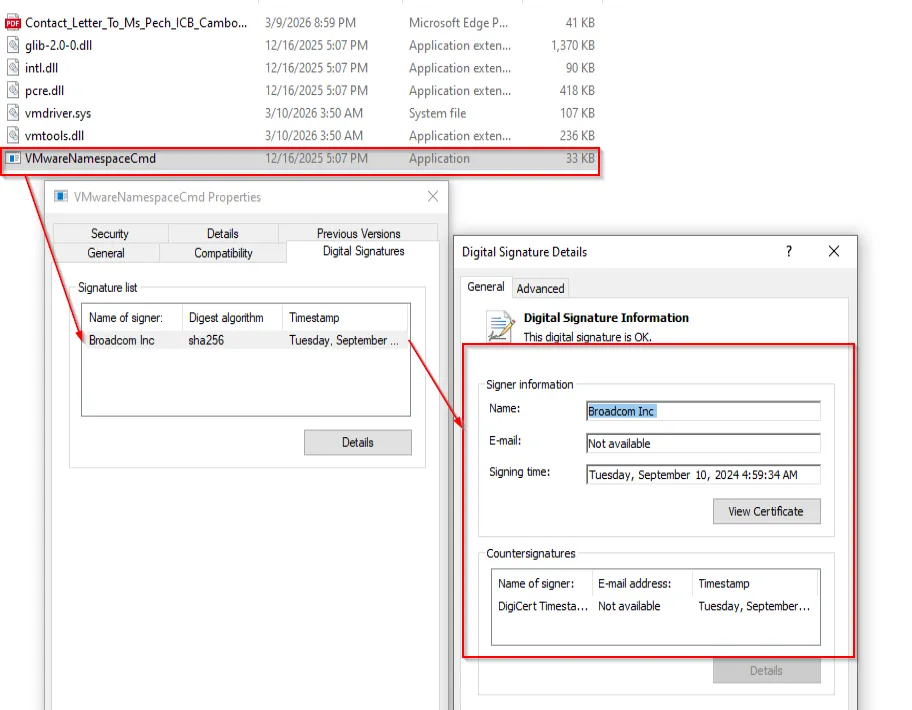
The archives masqueraded as PDF correspondence and contained a legitimate VMware binary, VMwareNamespaceCmd.exe, alongside a malicious vmtools.dll.
Because VMwareNamespaceCmd.exe statically imports functions from vmtools.dll, Windows loads the attacker-controlled DLL first, enabling the actor to sideload NIGHTFORGE under the context of a VMware-signed process.
One campaign included a convincing decoy letter addressed to an Information Collection Bureau (ICB) contact; the other omitted a decoy but otherwise mirrored the file structure and delivery chain.
NIGHTFORGE is a C++ DLL loader that decrypts and executes a companion shellcode payload.
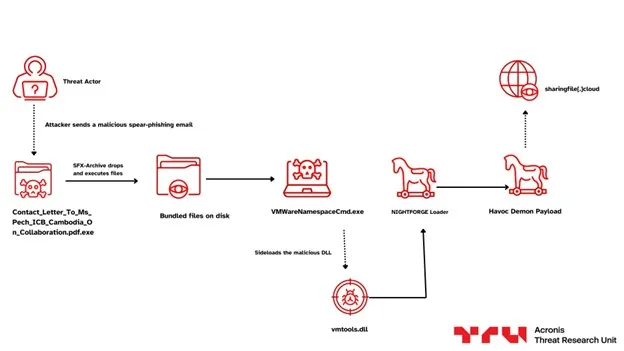
Acronis TRU has identified two targeted campaigns against Cambodian government entities, with focus on defense and military intelligence sectors, delivered by a cluster we’ve tracked as Khmer Shadow.
The loader demonstrates moderate technical sophistication: it resolves the running image path via the Process Environment Block, checks for staging and interactive sessions, hides foreground windows to reduce user visibility, and implements persistence through COM-based scheduled task creation under the name “VMwareNamespace” to blend with legitimate entries.
Hackers Abuse VMware-Signed Binary
NIGHTFORGE performs NTDLL unhooking by loading a clean ntdll from disk and overwriting the in-memory copy to remove defensive inline hooks, then resolves syscall numbers at runtime using the Hell’s Gate technique.
The loader decodes an XOR-obfuscated shellcode blob, allocates RWX memory and injects the payload via direct syscalls (NtAllocateVirtualMemory, NtWriteVirtualMemory, NtCreateThreadEx), enabling execution without user-mode monitoring footprints.
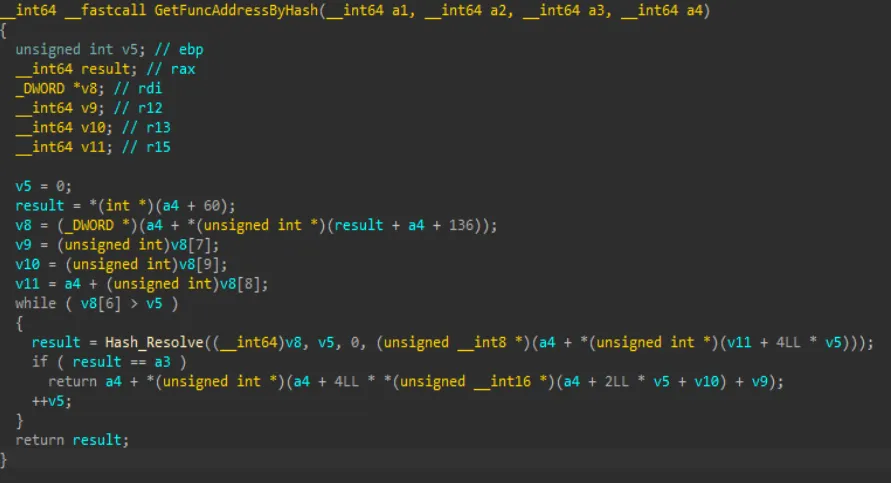
The injected payload chain includes KaynLdr, a reflective loader that locates an embedded PE, walks the PEB to find module bases, resolves required APIs via hashed exports, relocates and maps sections, and launches the final-stage implant. The ultimate payload is Havoc Demon, a variant of the open-source Havoc C2 framework.
Analysis of the Demon configuration shows HTTPS C2 traffic to www[.]sharingfile[.]cloud on port 443 using Chrome-like headers and five rotating endpoints (/national, /world, /sport, /download, /regular) designed to mimic normal web browsing.
The implant employs gpupdate.exe as a sacrificial process for injection and hides telemetry by matching common browser behavior in its HTTP profile.
Infrastructure pivoting revealed sharingfile[.]cloud registered via NameSilo and fronted by Cloudflare; the origin server identified via CriminalIP is hosted in Ukraine. JARM-based pivots uncovered a second domain, linkednewsapi[.]top, with near-identical server characteristics, suggesting common operational control.
TRU notes the operator reused payloads and infrastructure across targets with minimal retooling, which reduced OPSEC and enabled correlation.
While the use of vmtools.dll sideloading has precedent in other campaigns, TRU does not attribute Khmer Shadow to any known group at this time.
The cluster’s combination of advanced evasion NTDLL unhooking, Hell’s Gate, DLL sideloading and in-memory loading via KaynLdr alongside sloppy reuse of artifacts, points to an espionage-motivated operator actively developing capabilities but willing to trade operational hygiene for speed.
Indicators include the VMwareNamespaceCmd.exe/vmtools.dll sideload chain, NIGHTFORGE loader behaviors, KaynLdr reflective loading markers, and C2 domain sharingfile[.]cloud (Cloudflare edge 172.67.129[.]134; origin 193.169.240[.]38).
Security teams should block the listed domains and hashes, monitor cloudfronted HTTPS anomalies, enforce application allowlisting for signed binaries, and inspect for in-memory execution and abnormal scheduled tasks named “VMwareNamespace.”
IOCs
SHA256: Contact_Letter_To_Ms_Pech_ICB_Cambodia_On_Collaboration.pdf.exe 1852120a84a328edd1995e633dfd2009867898a8e3f0b385e2490cf21c77a994.
CN_Contact_Work_Cambodia’s_Ministry_of_Public_Works_and_Transport.pdf b3e853eee14fb7948c6907888ee07139085ba9af4231c30e97ff6236b86ca024.
Havoc Payloads 90bbfa9e7af176b85d110f4f1789cae6777fcb60813b047133c8f12caa344a17 15278c52f4e0d8b5bbfe288a5e826ab2ebeaedb7fb85572940cf1263e384761f.
Paths used for persistence: %LOCALAPPDATA%\VMwareNamespace\.
Scheduled task: Task name: VMwareNamespace.
Trigger: Daily, starting 2010-01-01T00:00:00, repeat every PT10M for P1D.
Logon type: TASK_LOGON_INTERACTIVE_TOKEN.
Previous task name (cleaned up by loader): driver.
C2 domains:
www[.]sharingfile[.]cloud.
linkednewsapi[.]top.
C2 origin IPs:
193[.]169[.]240[.]38 (SERVER.UA LLC, Kyiv, Ukraine).
104[.]193[.]255[.]99 (Hosting Solution Ltd., Santa Clara, U.S.).
Note: IP addresses and domains are intentionally defanged (e.g., [.]) to prevent accidental resolution or hyperlinking. Re-fang only within controlled threat intelligence platforms such as MISP, VirusTotal, or your SIEM.
Follow us on Google News, LinkedIn, and X to Get Instant Updates and Set GBH as a Preferred Source in Google.


