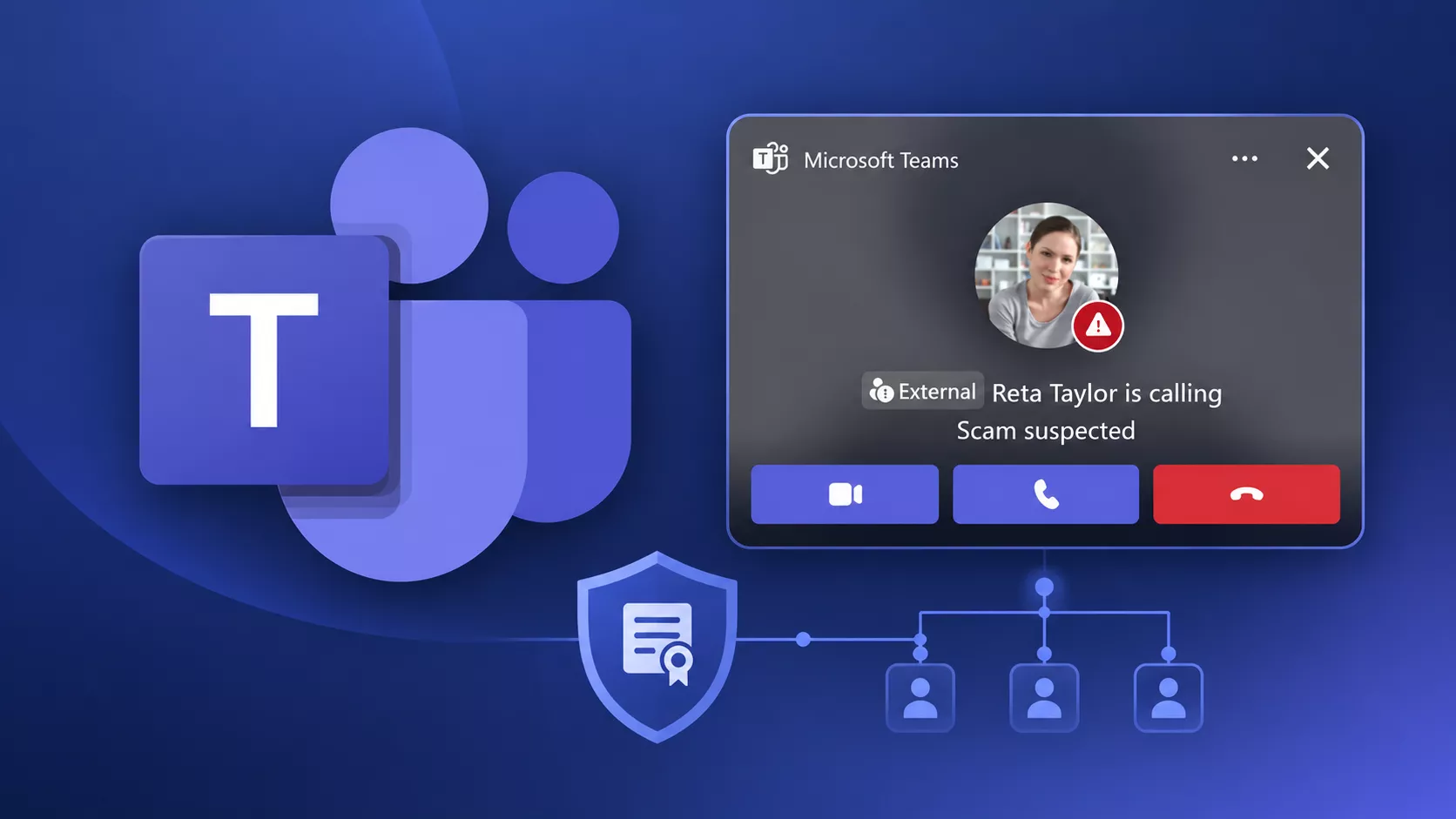

Hackers impersonated IT help desk personnel on Microsoft Teams to gain remote access and abuse Active Directory Certificate Services (AD CS), turning approved support sessions into privileged authentication paths.
Microsoft disclosed two intrusions on October 30, 2026, involving certificate template abuse and NTLM relay. The attacks did not exploit a Teams vulnerability.
Instead, operators combined social engineering with insecure AD CS configurations to obtain certificates representing privileged users or a domain controller. Microsoft has not attributed the activity to a specific threat actor.
Hackers Impersonate IT Help Desk on Microsoft Teams
Attackers contacted employees through Teams messages and calls, posing as support staff and persuading victims to launch Quick Assist and share connection codes.
Organization-themed tenant names and support-oriented display names helped make external contacts appear familiar. After gaining control, operators transferred archives into Downloads, extracted payloads into KB-prefixed directories under user profiles, and launched portable Python, Bun, or Java runtimes.

These components performed host discovery and assessed certificate services, with connections to domain infrastructure over LDAPS and SMB. In the first intrusion, attackers identified a certificate template vulnerable to ESC1.
Broad enrollment permissions, requester-supplied identity information, and weak issuance controls allowed a low-privileged account to request authentication certificates for privileged identities.
The initial phishing wave targeted three users and compromised one workstation. Attackers obtained certificates for three highly privileged accounts.
Approximately 90 minutes after disruption, another wave targeted 16 users, compromised another workstation, and secured certificates for eight additional privileged accounts.

Microsoft Defender blocked more than 1,000 subsequent SMB file-access attempts and additional logons. However, attackers performed DCSync within seconds of obtaining one privileged certificate while containment was taking effect.
One privileged account excluded from automated containment remained usable. Operators used it to access a file server and run Rclone renamed SearchApp.exe, copying files to an external SFTP destination.
In the second intrusion, attackers used PetitPotam over EFSRPC to coerce domain-controller authentication. They relayed the resulting NTLM authentication to insufficiently protected AD CS Web Enrollment, exploiting the ESC8 configuration weakness.
The attacker obtained a domain-controller certificate, used Kerberos PKINIT authentication, and received a ticket-granting ticket for that machine identity. Following Defender alerts, the customer isolated the workstation; Microsoft observed no further progression.

Microsoft recommends restricting external Teams access, verifying unsolicited support requests, controlling portable runtime execution, and reviewing certificate enrollment permissions. Enrollment endpoints should enforce HTTPS and Extended Protection for Authentication, and disable NTLM where feasible.
Responders must revoke unauthorized certificates and separately investigate Kerberos tickets: password resets do not revoke issued certificates, and certificate revocation does not invalidate existing tickets.
Indicators of compromise (IOC)
| Indicator | Type | Role |
| 85b6c424117494d3056e88689dbc94c75e9afdb187a339714043aec0da109f17 | SHA-256 | Initial Access Java Script |
| f326201269f1ee2f803ae435317507263bb6e0dbfdeb70bd1bb5446e2e46f001 | SHA-256 | Initial Access python script |
| 06c5c14f043aee3bcc5843b5f50909623d5c9a6239a7c1fba9cddad4111469e7 | SHA-256 | Initial Access python script |
Note: IP addresses and domains are intentionally Qdefanged (e.g., [.]) to prevent accidental resolution or hyperlinking. Re-fang only within controlled threat intelligence platforms such as MISP, VirusTotal, or your SIEM.
Join 16,000+ SOC teams using ANY.RUN to streamline threat investigations and reduce manual effort. Explore for your team


, turning approved support sessions into privileged authentication paths.)