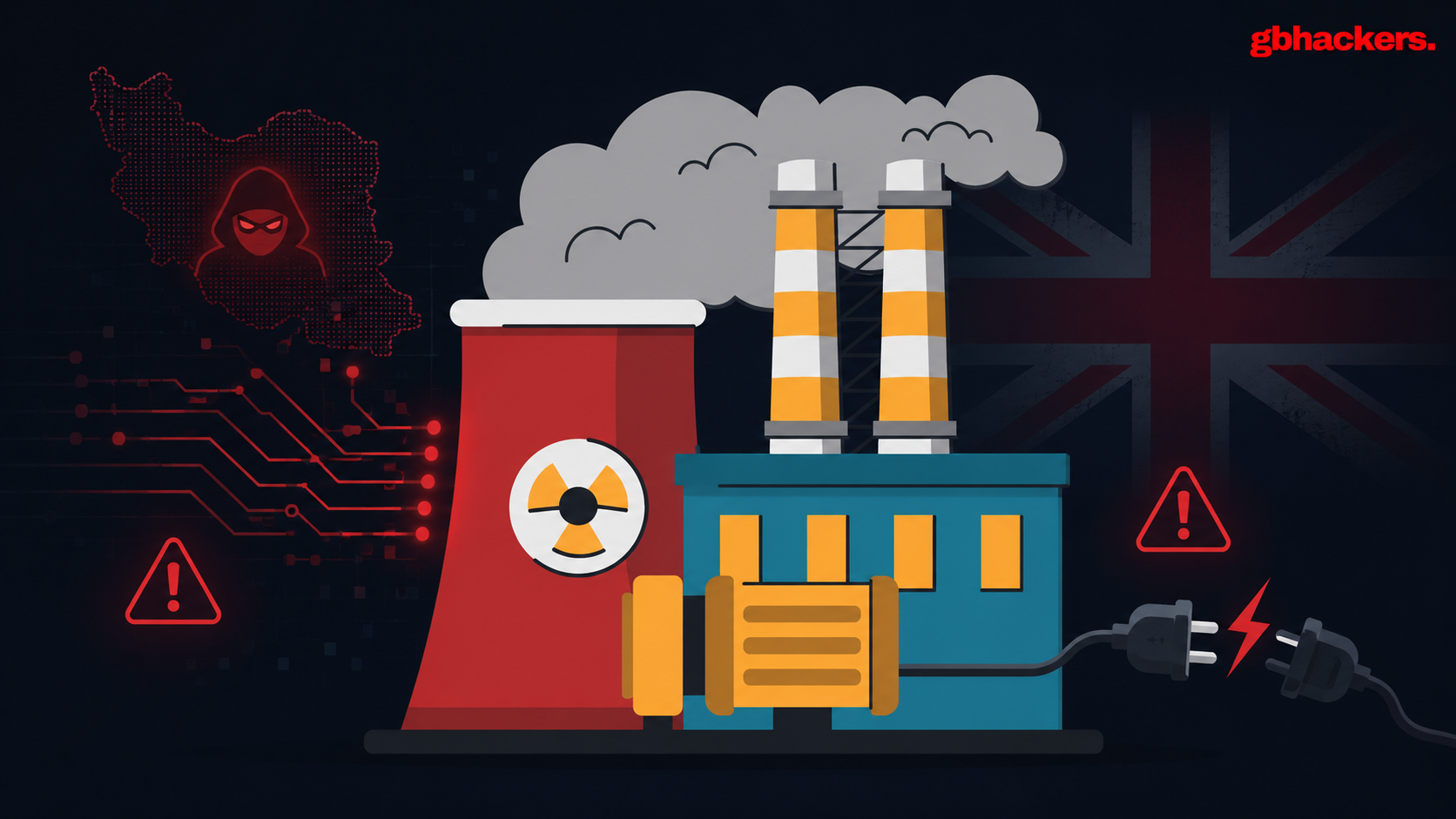

A cyber incident reportedly forced a small UK power generation facility offline for about four days in July 2026.
While the activity has been linked in reporting to Iran-affiliated hackers, the UK government and National Cyber Security Centre (NCSC) have not formally attributed the incident to Iran or any named threat group.
The event became public on August 22 after The Telegraph reported that suspected Iran-linked actors had disrupted a British energy facility.
Subsequent reporting by the Financial Times, Reuters, and other outlets indicated that the outage affected a small generator rather than a major power station.
The Department for Energy Security and Net Zero confirmed a cyber incident involving a “small-scale energy generator,” but did not identify the operator, site, or technology involved.
UK Energy Minister Michael Shanks said the affected asset was “tiny” relative to conventional power stations. He stressed that no consumers lost electricity, the broader grid was unaffected, and the incident created no threat to national energy security.
Officials nevertheless briefed energy-sector executives and continued coordination with regulators and the NCSC following the event.
Its limited grid significance, however, does not diminish the operational consequences of a multi-day shutdown at a physical generation facility.
The four-day recovery window is the most technically significant detail disclosed so far.
Public reporting does not explain whether the interruption resulted from direct interference with operational technology, a compromise of engineering or remote-management systems, or a precautionary shutdown during incident containment.
In industrial environments, restoring operations can require more than removing malicious access: operators may need to validate controller logic, engineering workstations, safety controls, network segmentation, and process configurations before returning equipment to service.
ThreatMon Researchers said that, the affected site was an approximately 15 MW gas-fired peaking plant. Such facilities supply additional generation during periods of elevated demand.
Iran-Linked Cyberattack
Crucially, no authoritative technical reporting has established the intrusion path. There is no public confirmation of phishing, credential theft, exploitation of a vulnerability, malware deployment, lateral movement into OT networks.
The identity of the affected facility, its industrial control vendors, and the presence of internet-facing systems also remain undisclosed. No incident-specific indicators of compromise have been released.
That distinction matters because several secondary accounts have circulated detailed claims about engineering-workstation compromise and industrial-system interaction.

Without corroboration from the operator, NCSC, government, or incident-response investigators, those claims should not be treated as a confirmed attack chain.
A reported operational consequence is not, on its own, evidence of direct PLC manipulation.
The incident coincided with heightened concern over Iranian-affiliated targeting of internet-exposed industrial environments in the United States.
On July 22, CISA and partner agencies updated Joint Cybersecurity Advisory AA26-097A, warning that Iranian-affiliated actors were targeting programmable logic controllers across critical-infrastructure sectors.
The update expanded the observed vendor scope to include Rockwell Automation/Allen-Bradley, Schneider Electric, and Siemens systems, while adding detection guidance for malicious modifications to reusable PLC code modules.
The advisory demonstrates that Iranian-affiliated actors were actively pursuing reachable OT devices during the same period, including systems used in energy and water environments.
But it does not establish a technical connection to the UK event. There is no published infrastructure overlap, malware correlation, shared IOC set, named actor, or confirmed TTP match between the British outage and the PLC-focused activity described in AA26-097A.
The case nevertheless highlights an enduring OT-security problem: small facilities can be operationally vulnerable even when their loss does not threaten national supply.
Distributed generation sites often rely on remote administration, industrial engineering systems, third-party connectivity, and digitally controlled processes that can create meaningful exposure if asset visibility, authentication, and recovery procedures are weak.
For UK defenders, the central lesson is not the temporary loss of 15 MW. It is that cyber resilience must extend beyond the largest power stations to the smaller, distributed assets that collectively support critical infrastructure.
★ Which Security Tools Should You Cut? Score Them on One Page – Download the Inherited Security Stack Guide