A previously undocumented Rust-based infostealer they call KuinaExtractor, a family that has evolved from a capable early prototype into a hardened, stealth-focused threat now rebranded as “k0to.”
Analysis of dozens of samples and function-level code comparisons reveals a clear single-operator lineage, steady feature expansion, and deliberate moves toward concealment rather than new capabilities.
The actor’s artifacts shared mutex names, build-host paths, repeated Telegram handles and Vietnamese-language strings link the builds and point toward a Vietnamese-speaking developer and Vietnam-hosted infrastructure as supporting signals.
The earliest KuinaExtractor builds, observed in December 2025, already implemented broad credential theft.
They collected browser cookies, crypto-wallet artifacts, Windows credential store data, Roblox cookies and session tokens, Steam sessions and Discord tokens, and included a sophisticated Chrome App-Bound-Encryption bypass that impersonated LSASS to recover master keys.
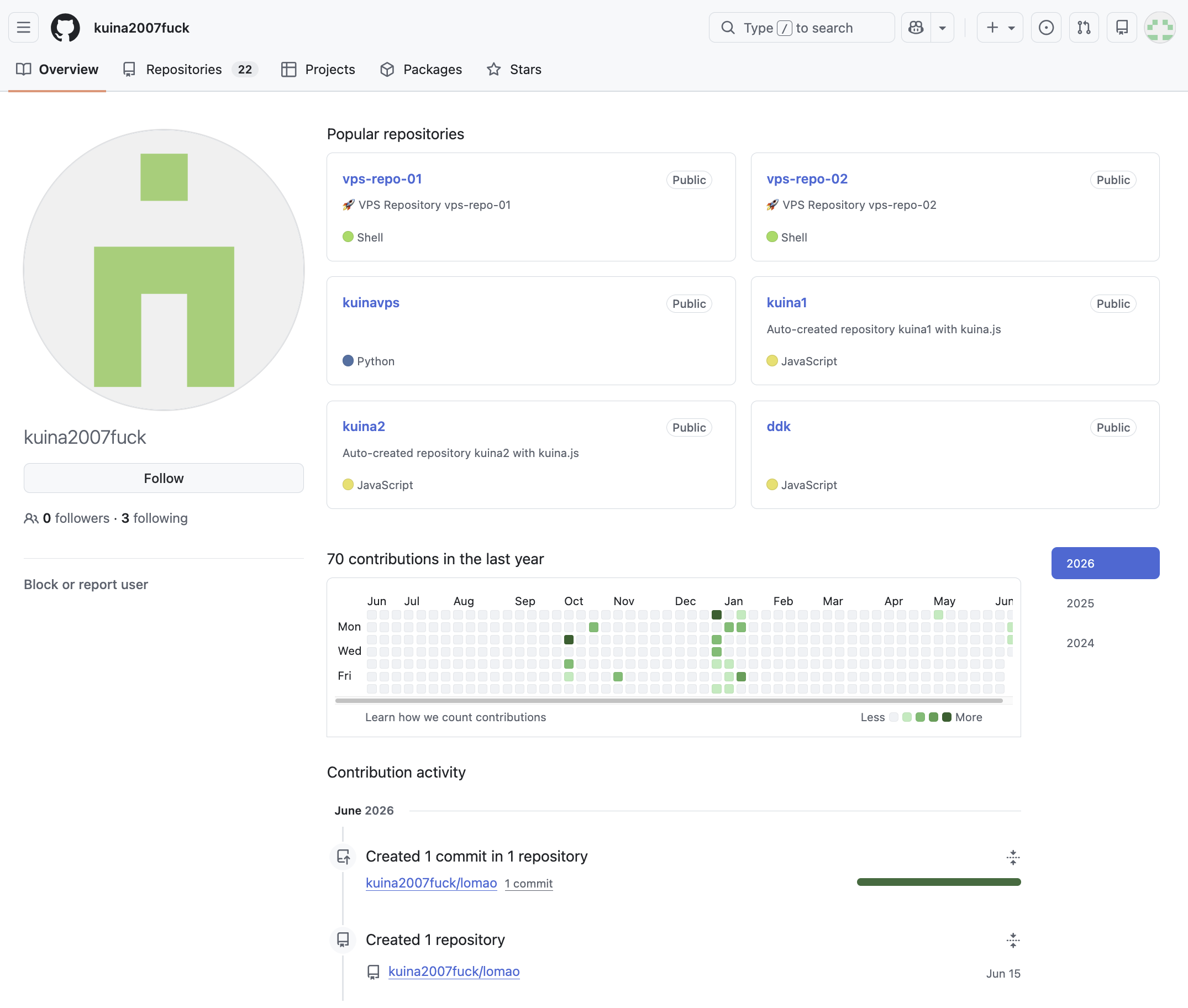
Exfiltration used a Discord webhook and privilege escalation relied on a single fodhelper/ms-settings UAC bypass. The actor employed GitHub both for content delivery and briefly as throwaway VPS/RDP infrastructure via GitHub Actions. (See linked analysis report for the December lineage.)
According to Threatray, rapid rewrite in January 2026 introduced extensive reconnaissance and modularized privilege escalation. The rebuilt stealer added WMIC hardware enumeration, Wi‑Fi SSID harvesting, a Windows Credential Manager dump.
KuinaExtractor Stealer
The UAC bypass became a function-pointer table exposing seven potential escalation methods, and exfiltration migrated from Discord to a Telegram bot access. These changes reflect an operator maturing from capability proof toward operational reliability.
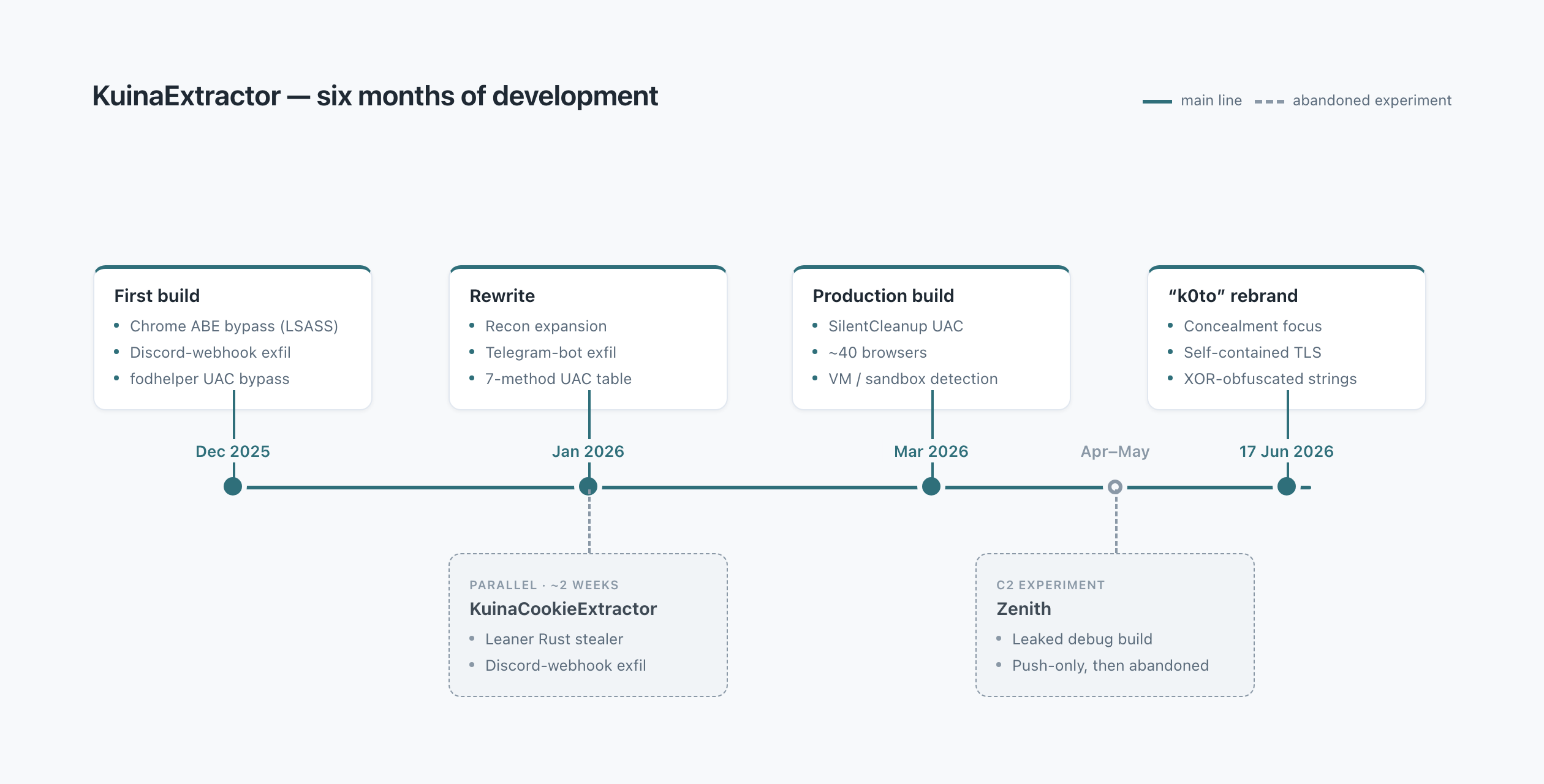
By March the family had converged on a production-grade build that remained in use for months. The cookie-theft core persisted the same LSASS/ABE chain extended to ChaCha20-Poly1305 to handle modern Chrome versions while broader hardening increased anti-analysis and evasion.
The stealer expanded browser coverage to roughly 40 targets, explicitly including the Vietnamese CocCoc browser, and adopted virtual machine and sandbox detection checks.
The UAC technique shifted to SilentCleanup, and telemetry shows the March variant continuing active deployment.
On 17 June the operator rebranded binaries to “k0to” and prioritized concealment. The new build embeds a self-contained HTTP stack (reqwest over hyper with rustls), ships its own CA roots to bypass the system TLS store, and XOR-obfuscates strings (28-byte key), including the Telegram C2 URL.
It also adds a sandbox check that scans PowerShell window titles for analyst tooling and converts the Telegram channel to one-way, accepting file uploads without polling for commands. These changes reduce observable network artifacts and complicate defender detection.
Parallel short-lived experiments accompanied the mainline development. KuinaCookieExtractor, visible briefly in January, targeted Roblox, Steam, Minecraft, FileZilla, Telegram tdata and Discord, exfiltrating to Discord webhooks; markers tie it to the main author but its lighter anti-analysis led to quick abandonment.
The Zenith C2 experiment in late April/early May produced a debug build that left verbose logging on the desktop and briefly exposed a panel at a Vietnamese-hosted IP; it too was dropped.
KuinaExtractor’s modular Rust codebase, staged rewrites and infrastructure adjustments illustrate an operator balancing rapid feature development with operational security improvements.
The family’s focus on browser data, crypto wallets and high-value gaming/service credentials (Roblox, Steam, Discord) makes it especially relevant to both consumer victims and criminal resale markets.
Threat actors and defenders should note the Chrome App-Bound-Encryption bypass, the transition to TLS stacks that do not rely on system stores, and the move to push-only exfiltration channels techniques that complicate detection and takedown.
Follow us on Google News, LinkedIn, and X to Get Instant Updates and Set GBH as a Preferred Source in Google.