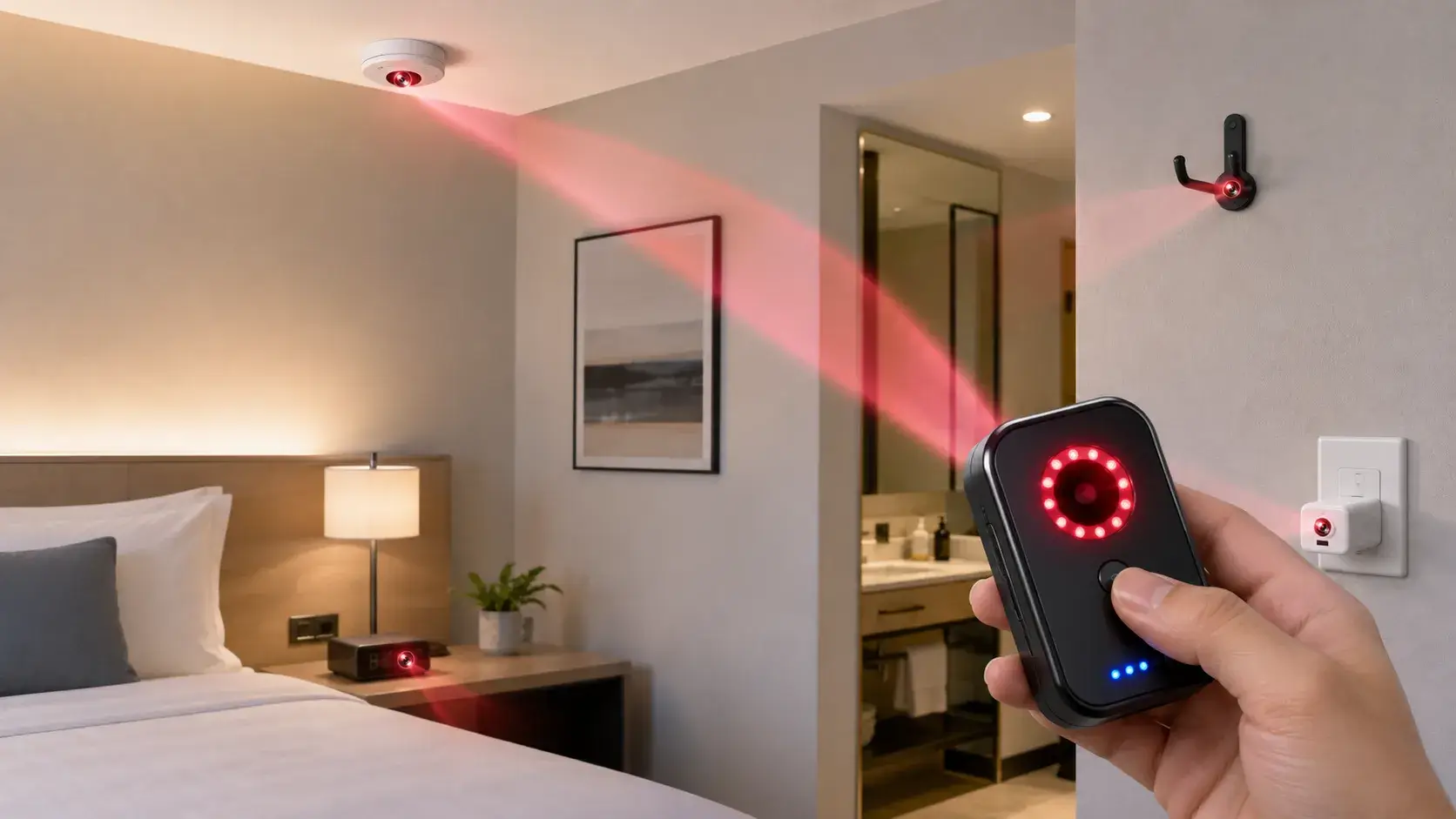

Researchers have developed SweepLED, a smartphone-based hidden-camera detection system that uses a low-cost LED accessory and computer vision to identify concealed lenses in under five seconds.
The system is detailed in the research paper titled “Hide-and-Sweep: Detecting Concealed Cameras via LED Illumination Sweeps.” It is designed to help users identify covert cameras hidden in common items such as clocks, chargers, smoke detectors, motion sensors, pens, and power adapters.
Unlike traditional hidden camera detectors that require users to inspect reflections through a viewfinder manually, SweepLED integrates a smartphone camera with a compact LED-array accessory shaped like a phone case. According to the researchers, the core components of the prototype cost less than $7.
How SweepLED Works
SweepLED operates by changing the angle of illumination while keeping the smartphone camera relatively still. During a scan, the LEDs embedded in the accessory activate sequentially, casting light on a potentially suspicious object from multiple directions.
The smartphone records the changes in reflected light. It sends the data to a machine-learning algorithm trained to distinguish camera lenses from everyday shiny surfaces.
This approach addresses a significant limitation of existing optical camera finders: materials such as metal, plastic, glass, and glossy decorations can create bright reflections that may resemble a camera lens at a single light angle. Such false positives make conventional detectors difficult for untrained users to operate reliably.
The researchers found that a real camera lens produces a different reflection pattern when the light source is moved. Ordinary reflective surfaces typically generate highlights that slide across the surface while maintaining a similar shape. However, camera lenses consist of a lens, an aperture, a barrel, and an image sensor assembly.
When illuminated from varying angles, these optical components can partially block or redirect light, causing the reflected spot to deform into structured patterns, such as “cat-eye” or crescent shapes, rather than just moving across the object.
SweepLED captures these temporal changes through several processing stages:
- Video stabilization compensates for small hand movements while the user holds the phone.
- Difference-frame processing isolates LED-generated reflections from ambient lighting.
- A Faster R-CNN model identifies candidate lens-like reflective regions.
- Cross-frame refinement retains reflections that persist during the LED sequence.
- A spatiotemporal classifier analyzes RGB footage and optical-flow data to determine whether a persistent reflection is likely to be a hidden lens.
For improved reliability, users are advised to scan an object from three slightly different viewpoints. Each sweep lasts about 1.5 seconds, resulting in a total inspection time of roughly 4.5 seconds per object.

In tests involving 12 commercially available hidden-camera objects and 18 reflective non-camera objects, SweepLED achieved an overall accuracy of 93.9%. It detected hidden-camera objects at an average rate of 95% and recorded a 7.2% false-positive rate for non-camera objects.
The researchers also noted that the system remained effective under various indoor lighting conditions and with multiple smartphone models, including Samsung Galaxy, Google Pixel, and OnePlus.
Detection accuracy remained high at distances up to 80 centimeters but decreased at 100 centimeters, as lens reflections became harder to isolate. Full HD video maintained strong performance, whereas lower qHD-quality footage significantly reduced accuracy.
While the technology is still a research prototype and not yet a retail product, it does have limitations. It can struggle when a concealed lens is hidden behind heavily tinted, opaque, or strongly diffusive materials that block visible light.
Despite these challenges, SweepLED presents a potentially practical solution for privacy defense: a travel-friendly smartphone accessory that could help hotel guests, short-term rental users, and property inspectors quickly investigate suspicious objects without relying solely on RF scans. Unlike RF-based detectors, this optical technique may also identify cameras that are not actively transmitting wirelessly.
Keep your SOC up to date on active malware & phishing within 24h of their emergence. Try ANYRUN to prevent incidents with early detection.