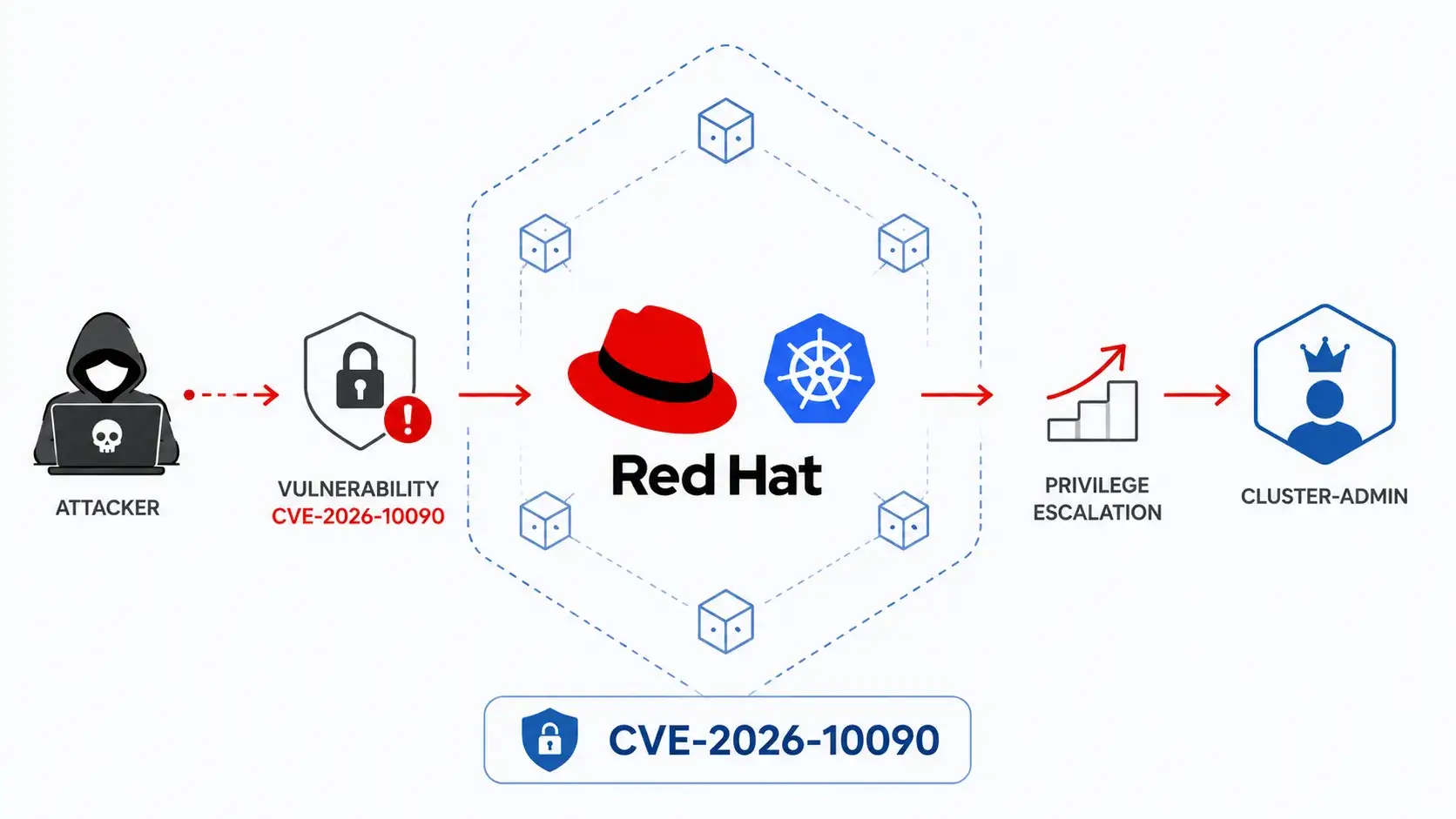

Red Hat has disclosed a privilege-escalation vulnerability in Red Hat Advanced Cluster Management for Kubernetes (ACM) that could allow a low-privileged user to gain full cluster-admin control of an affected hub cluster.
This vulnerability is tracked as CVE-2026-10090 and affects the Application Subscription controller, specifically the multicluster-operators-subscription. It has a CVSS v3.1 score of 9.9 out of 10.
Red Hat Kubernetes Flaw
The issue arises from an authorisation gap in ACM’s application-subscription workflow. A user with namespace-scoped edit permissions in an ACM hub namespace can create a Channel object that points to an attacker-controlled Helm repository.
They can then create a Subscription that refers to that Channel. The vulnerable controller retrieves and deploys the chart using its own elevated permissions.
Importantly, the controller does not verify whether the creator of the Subscription has the open-cluster-management:subscription-admin role, nor does it enforce the proper namespace boundaries on resources delivered through the Helm chart.
This creates a “confused deputy” problem: a user with delegated namespace rights can cause a privileged controller to perform cluster-wide actions on their behalf.
An attacker can exploit this trust boundary by including cluster-scoped Kubernetes objects in the malicious Helm chart.
Red Hat specifically highlighted that a ClusterRoleBinding could associate an attacker-controlled ServiceAccount with Kubernetes’ cluster-admin ClusterRole. Once applied, this binding grants the attacker unrestricted access to the control plane.
Having cluster-admin access enables an intruder to read Kubernetes Secrets, deploy or modify workloads, create persistent backdoors, tamper with admission or policy controls, and disrupt applications across namespaces.
Red Hat classified CVE-2026-10090 as Important and published details about it on August 5, 2026. Its CVSS vector is AV:N/AC:L/PR:L/UI:N/S:C/C:H/I:H/A:H, indicating network reachability, low attack complexity, low required privileges, no user interaction, and high impact on confidentiality, integrity, and availability.
The vendor lists the Red Hat Advanced Cluster Management for Kubernetes 2, specifically the rhacm2/multicluster-operators-subscription-rhel9 component, as affected. No security erratum was provided at the time of publication.
Red Hat stated that no mitigation currently meets its product-security criteria, leaving organizations to focus on reducing exposure while monitoring for a fix.
Security teams should identify ACM hub namespaces where non-administrators retain edit rights, review Channel and Subscription objects, validate the ownership and provenance of Helm repositories, and search for unexpected ClusterRoleBindings, ClusterRoles, ServiceAccounts, or cluster-scoped resources associated with subscription deployments.
Teams should also implement least-privilege RBAC, limit who can create or modify Channels and Subscriptions, and set up alerts for controller-driven creation of cluster-scoped objects.
Because this flaw violates ACM’s documented expectation that non-subscription-admin users can only deploy into their own subscription namespace, organizations should view any cross-namespace or cluster-scoped deployment as suspicious and treat it with heightened urgency until a remediation is available.
Red Hat credited Christopher Lusk of North Echo Security Research for reporting the issue.
Stop new phishing & malware before they compromise your business. Integrate live intel from 15K SOCs around the world



 that could allow a low-privileged user to gain full cluster-admin control of an affected hub cluster.)