

In an era defined by economic volatility and corporate restructuring, cybercriminals are weaponizing workforce anxiety to launch sophisticated cyberattacks.
A new campaign identified by cybersecurity researchers at Seqrite Labs reveals that threat actors are exploiting fears of job loss to distribute the notorious Remcos Remote Access Trojan (RAT).
By mimicking urgent Human Resources correspondence, attackers are successfully tricking Windows users into compromising their corporate networks.
The campaign capitalizes on the high-stress atmosphere surrounding current labor market trends, including hiring freezes and aggressive cost-cutting.
The attack vector begins with a phishing email masquerading as an official internal memo from a company’s HR department. The messages are brief, formal, and specifically reference a “Staff Performance Report for October 2025.”
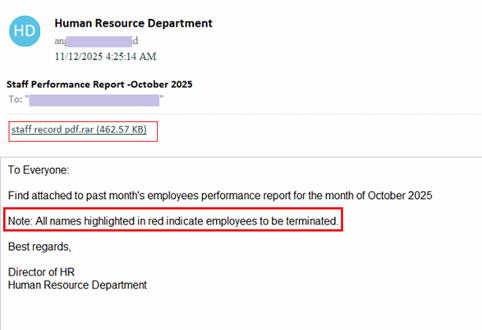
Crucially, the body of the email alludes to a list of “employees to be terminated,” a lure calculated to bypass rational scrutiny and prompt nervous employees to open the attachment immediately out of fear or curiosity.
Remcos RAT Phishing Campaign
While the email claims to contain a PDF document a standard format for corporate policy updates the attachment is actually a deceptive archive file named staff record pdf.rar. This archive contains a single file: staff record pdf.exe.
This “double extension” technique is a classic obfuscation method designed to hide the file’s true executable nature from users, particularly when file extensions are hidden by default in Windows.
Seqrite Labs’ analysis reveals that the executable is wrapped in an NSIS (Nullsoft Scriptable Install System) installer.
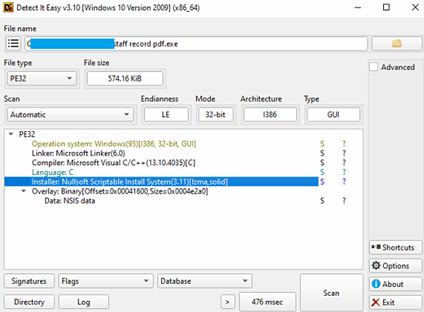
While NSIS is a legitimate tool used for creating Windows installers, it is frequently abused by malware authors to package malicious payloads in a way that helps evade detection by traditional antivirus signatures.
Once a victim executes the fake PDF, the Remcos RAT initiates a stealthy infection chain. The malware drops configuration files into the Windows Start Menu and copies itself to the c:\ProgramData\Remcos\ directory.
To ensure it remains active even after a system reboot, Remcos achieves persistence by adding an entry to the Windows Registry under the Run key.
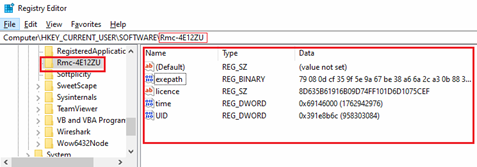
It also creates a unique registry entry (HKCU\Software\Rmc-<VictimID>) to store encrypted configuration data, including the license key and the timestamp of the infection.
The Remcos RAT is a potent surveillance tool. Upon establishing a connection with the attacker’s Command and Control (C2) server, it spawns multiple threads capable of invasive espionage.
These capabilities include keylogging to steal credentials, screen capturing to monitor user activity, and clipboard monitoring to hijack sensitive copied data.
This campaign serves as a stark reminder that technical defenses must be paired with user awareness. As layoffs continue to dominate the news cycle, employees are urged to exercise extreme caution with unsolicited HR communications.
Security teams are advised to reinforce email filtering rules to flag double-extension files and executable archives, while organizations should remind staff to verify the authenticity of sensitive internal documents through out-of-band communication channels before clicking.
Follow us on Google News, LinkedIn, and X to Get Instant Updates and Set GBH as a Preferred Source in Google.







