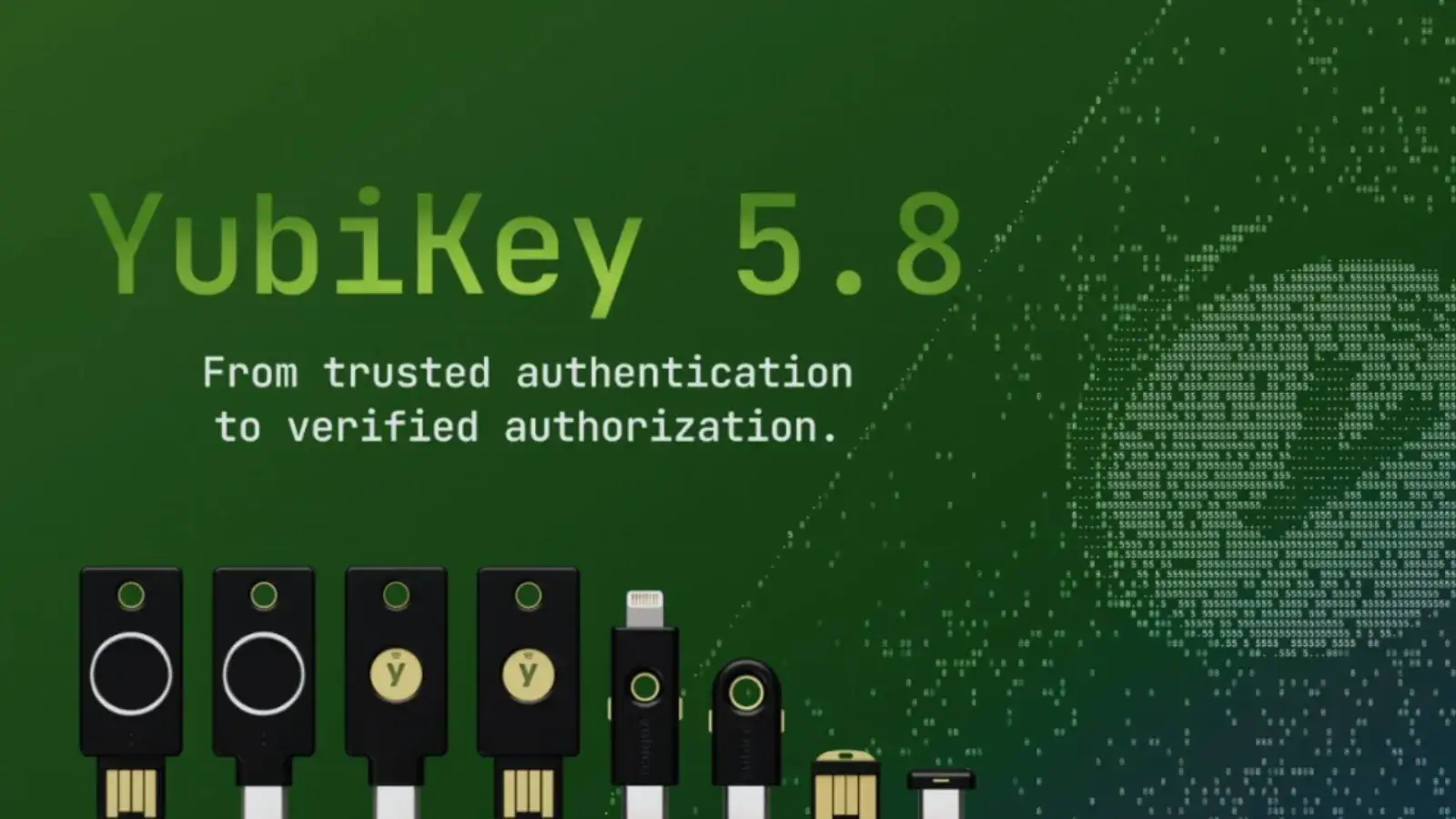

Yubico has released the YubiKey firmware version 5.8, expanding its hardware security key platform beyond phishing-resistant authentication.
This update introduces verifiable, hardware-backed authorization for digital signatures, identity wallets, payment confirmations, and AI agent approval workflows.
Announced on July 21, 2026, this firmware update aims to help enterprises verify not only who accesses an application but also what specific high-impact actions a human user or autonomous AI agent is authorized to perform.
Yubico Launches YubiKey 5.8
The launch comes at a time when organizations are increasingly deploying generative AI and agentic systems capable of initiating transactions, accessing business data, approving workflows, and executing operational tasks at machine speed.
Traditional multi-factor authentication primarily validates a user at login, leaving a gap when systems need to verify intent for individual actions. The YubiKey 5.8 aims to bridge that gap by enabling cryptographic proof that is tied to hardware-backed user verification for sensitive approvals and signatures.
A core feature of this release is support for the Client to Authenticator Protocol (CTAP) version 2.3, along with preview support for the emerging WebAuthn signing extension.
These standards-based capabilities enable developers to integrate high-assurance signing workflows through familiar web authentication APIs instead of needing to build and maintain custom cryptographic infrastructure.
This could facilitate use cases such as signing enterprise documents, validating verifiable credentials, approving AI-generated actions, and authorizing high-risk changes within cloud or identity environments.
For AI-driven workflows, this technology provides an essential human-in-the-loop safeguard. Enterprises could require a YubiKey-backed signature before an AI agent submits a payment, provisions privileged access, changes a production configuration, or approves a legally binding document.
This approach creates a tamper-resistant authorization checkpoint, helping security teams to distinguish legitimate, explicitly approved actions from unauthorized or manipulated agent requests.
Additionally, the YubiKey 5.85.85.8 expands Enterprise Attestation support to 16 different Relying Party IDs on a single device. This enables organizations to uniquely identify and manage a security key across different development, testing, staging, and production environments, including deployments that span multiple identity providers.
The feature is designed to improve enterprise device assurance while maintaining user privacy controls that are built into FIDO-based authentication.
The update also introduces persistent PIN or user-verification authorization tokens, which Yubico claims can reduce unnecessary PIN prompts and facilitate smoother credential discovery and selection.
Combined with autofill-like discovery for hardware-backed credentials alongside software passkeys, these changes aim to reduce enrollment friction, user confusion, and identity-related helpdesk overhead during the adoption of passkeys.
Yubico also emphasized support for emerging digital identity wallet initiatives, privacy-enhancing algorithms for verifiable credentials, and Secure Payment Confirmation (SPC) scenarios for web-based payments. These capabilities position the YubiKey as a physical root of trust for transactions where authentication alone is insufficient.
The YubiKey 5.8 is being shipped across major YubiKey product lines and retains all functionality available in firmware version 5.7.45. The YubiKey FIPS Series and CCN Series will continue on version 5.7.45 while their respective certification and recertification processes are ongoing.
ALERT: 20+ government sites delivered malware to businesses and citizens. See full attack research to check your own exposure.


