

Google has recently discovered a new variant of the Rowhammer bug named “Half-Double”, which takes the advantage of physical aspects of DRAM chips to modify the memory contents.
This new variant of the Rowhammer bug is named Half-Double by Google, and initially, it was unveiled in 2014, and still, this flaw is present in the most advanced DDR4 chips.
The security researchers at Google have explained that Rowhammer is basically an attack that is based on the design of modern DRAM memory chips, where the memory blocks are stocked in a lattice.
Half-Double
By exploiting this attack a threat actor can easily read and write the operations into rows of memory cells in an accelerated mode through a malicious application.
Even due to the small size of the chips, repeated access to the bits in the individual memory cells allows the contents of the neighboring memory cells to be read as well.
The small electromagnetic field is formed inside the rows of the memory cells due to the cells, as in a very short period of time the cells change their value from 0 to 1 and vice versa.
The aspect of electrical coupling allows circumventing the hardware and software protections. Due to which any infected code can then gain complete control of the system.
The error that occurs in nearby rows of cells due to the influence of the electromagnetic field, results in bit flips and data alteration in the neighboring rows.
This bug usually affects the two tangent lines, but the experts at Google have discovered, with Half-Double the Rowhammer effect disseminates over a greater distance.
While the cybersecurity analysts were able to take advantage of the effect of an electromagnetic field on memory cells, and altered the data on them, according to a 2014 research.
As per the initial study, the Rowhammer attack only worked against DDR3 RAM memory chips only, as earlier the same type of attack with Rowhammer was executed by the attackers, and named it as RAMBleed.
But, the security researchers continued their research, and now using the JavaScript code embedded in a web page they managed to attack the DDR4 RAM memory chips.
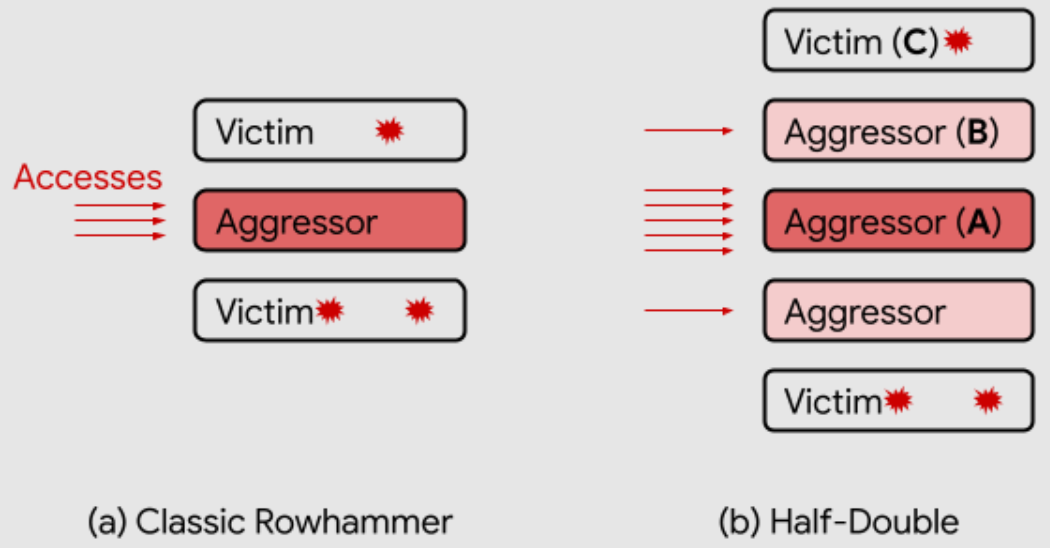
Security experts at Google explain that row C can also be accessed by making a large number of accesses to row A and a dozen of accesses to row B. And it clearly depicts that the electrical coupling has longer-range consequences with minimizing the size of memory cells.
“Rather than only testing at individual distances, a DRAM vendor should test a mix of hammering distances to evaluate the effectiveness of a [SoC-level] mitigation,” noted the analysts at Google.
With the passing years, the RAM cards have become compact due to which the spacing between rows of memory cells has also decreased. And as a result, the electromagnetic field of Rowhammer covers more cells in current variants of RAMs, as compared to the RAMs of 2014.
You can follow us on Linkedin, Twitter, Facebook for daily Cybersecurity and hacking news updates.







