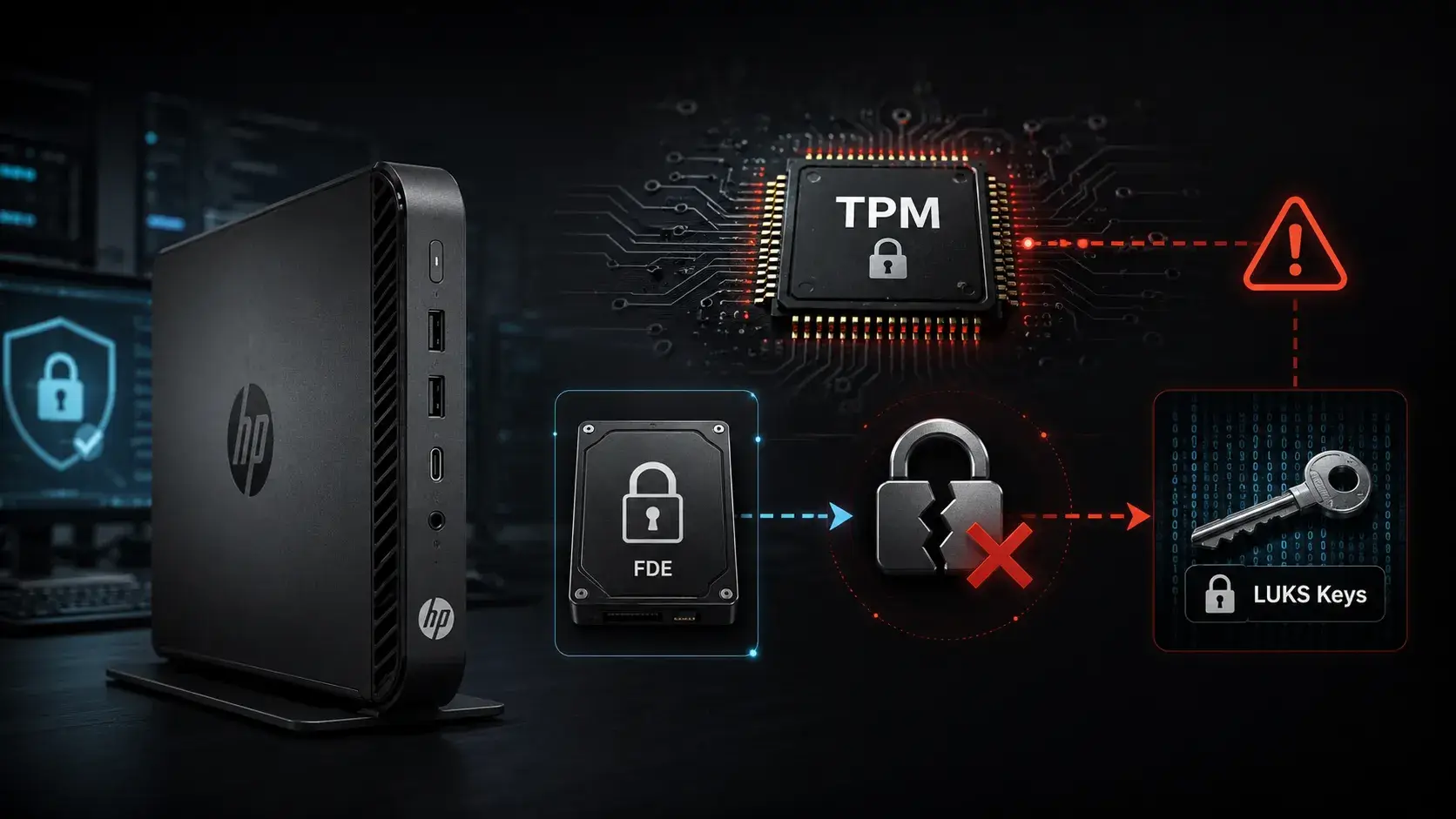

A security researcher has revealed a critical design flaw in HP ThinPro versions 8 and 9, which allows attackers with physical access to a thin client’s storage drive to extract TPM-sealed LUKS disk-encryption keys.
This vulnerability arises from an incomplete measured-boot policy that validates the GRUB bootloader but fails to measure the Linux kernel and initramfs it loads.
HP ThinPro TPM Flaw
Researcher Darren McDonald discovered the issue while examining HP t530 and t540 thin clients running ThinPro. These devices store the operating system on a LUKS2-encrypted Btrfs partition, with a TPM-sealed key that unlocks the partition at boot.
This design theoretically protects sensitive data, even if an attacker removes the device’s M.2 SATA drive.
However, the TPM policy checks only Platform Configuration Registers (PCRs) 0, 2, and 4. These PCRs measure the firmware, option ROMs, UEFI drivers, and the GRUB binary, respectively.
They do not account for the Secure Boot state, GRUB configuration, Linux kernel, or initramfs. This oversight allows an attacker to keep the trusted GRUB binary unchanged while modifying unmeasured boot components.
ThinPro’s TPM key-release process relies on an initramfs shell script called unseal_key. During normal startup, this script invokes HP’s hptc-tpm-tool, receives the unsealed LUKS key from the TPM, and directly sends it to cryptsetup to unlock the encrypted root partition.
The initramfs resides on an unencrypted BOOT partition and can be modified with standard archive management tools. An attacker can alter the unseal_key script so that, when the TPM releases the secret, it copies the LUKS key to the unencrypted BOOT partition before continuing the normal boot sequence.
Since the modified initramfs is not included in the TPM’s PCR policy, the TPM detects no policy mismatch and releases the key. The thin client then continues booting normally, providing little immediate indication that its disk-encryption key has been compromised.
According to the AmberWolf, with the exposed raw 32-byte key, an attacker can unlock the encrypted ThinPro partition and access the device’s configuration data, credential and certificate stores, and password hashes for local root and user accounts.
Affected Versions and Impact
McDonald confirmed the issue on:
- HP t530 devices running ThinPro 8.1.0 build 22
- HP t540 devices running ThinPro 9.0.0 build 15
Although the underlying defect affects both versions, their initramfs formats differ; ThinPro 8 uses a single compressed CPIO archive, while ThinPro 9 employs a multi-segment image that includes microcode archives before the main compressed filesystem.
The researcher assigned the vulnerability a CVSS v3.1 score of 6.1, classifying it as Medium: AV:P/AC:L/PR:N/UI:N/S:U/C:H/I:H/A:N. While exploitation requires physical access, it is low-complexity and requires no privileges or user interaction. Additionally, it can compromise both confidentiality and integrity.
Mitigation Status
HP PSIRT was reportedly notified of the issue on February 22, 2026. HP has confirmed that a fix is in quality assurance; however, as of August 8, no patch, security bulletin, or CVE had been published.
Administrators are advised to enable Secure Boot and set BIOS passwords to increase resistance against tampering. However, these measures do not address the fundamental gap in PCR measurement.
Organisations should consider ThinPro full-disk encryption inadequate protection once a device leaves their physical control, and securely destroy storage media during disposal.
Stop new phishing & malware before they compromise your business. Integrate live intel from 15K SOCs around the world