

A sophisticated Linux malware framework, VoidLink, has been identified by Check Point Research, representing a significant escalation in threats targeting cloud-native environments.
The advanced framework, developed by Chinese-affiliated developers, combines custom loaders, implants, rootkits, and over 30 modular plugins specifically engineered to maintain persistent access to Linux systems while evading detection through multiple layers of operational security mechanisms.
Written in Zig, the malware employs a modular architecture centered around a custom Plugin API inspired by Cobalt Strike’s Beacon Object Files approach.
The framework’s flexibility allows threat actors to select and deploy only necessary capabilities, reducing footprint while maximizing operational effectiveness.
The malware’s development artifacts suggest active iteration and refinement, with samples containing debug symbols indicating ongoing enhancement of capabilities.
This rapid development cycle indicates the developers possess advanced technical expertise across multiple programming languages, including Go, Zig, C, and modern web frameworks such as React.
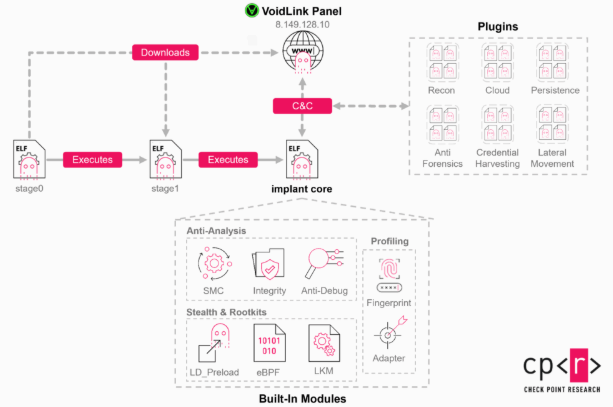
VoidLink represents a departure from typical Linux malware, demonstrating enterprise-grade sophistication comparable to mature Windows-based command-and-control frameworks.
The developers also demonstrate sophisticated knowledge of operating system internals, enabling implementation of kernel-level rootkit functionality.
Cloud-First Threat Landscape
What distinguishes VoidLink from conventional Linux malware is its explicit design for cloud environments. Upon execution, the malware performs extensive reconnaissance to identify the cloud provider hosting the compromised system.
Currently, it detects AWS, GCP, Azure, Alibaba, and Tencent, with plans to support Huawei, DigitalOcean, and Vultr. The malware subsequently queries cloud provider metadata APIs to gather detailed information about the compromised instance.
The framework extends reconnaissance capabilities to containerized environments, actively detecting Docker containers and Kubernetes pods.
This cloud-native focus indicates threat actors are specifically targeting software engineers and infrastructure administrators whose workstations interface directly with cloud environments.
The harvesting of credentials associated with Git repositories and cloud services suggests potential supply-chain attack objectives.
VoidLink implements multiple sophisticated operational security mechanisms designed to maintain covert operations.
Upon deployment, the malware enumerates installed security products and kernel hardening technologies, calculating a risk score for the environment and adapting behavior accordingly.
In highly monitored environments, the framework reduces scanning aggressiveness and increases timing intervals between command-and-control communications.
The self-deletion capability activates if tampering is detected, ensuring removal of malicious artifacts.
Additionally, VoidLink employs runtime code encryption, decrypting protected code regions during execution and re-encrypting them afterward to evade memory scanners.
The framework includes multiple rootkit implementations LD_PRELOAD, eBPF, and Loadable Kernel Modules deployed based on kernel version and detected capabilities, enabling selective hiding of processes, files, network sockets, and the rootkit modules themselves.
Command-and-Control Infrastructure
The framework includes a comprehensive web-based dashboard providing operators with complete control over deployed agents and plugins.
The interface, localized for Chinese-speaking operators, organizes functionality into Dashboard, Attack, and Infrastructure sections.
The dashboard features an implant builder enabling custom variant generation with configurable evasion posture and beaconing intervals, alongside a plugin management panel supporting deployment of the 37 available default modules.
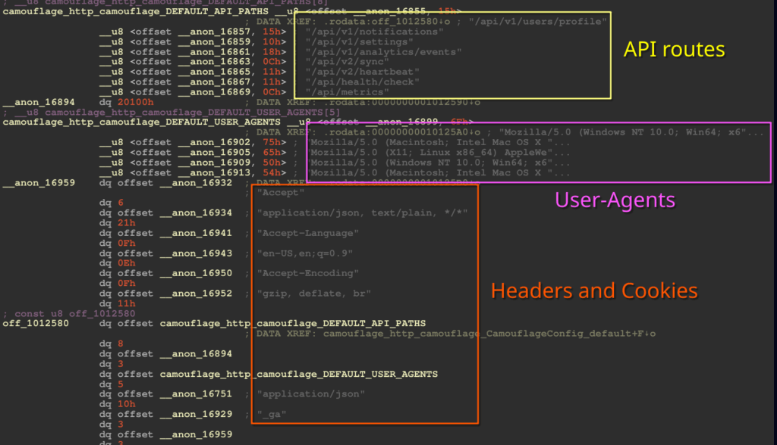
VoidLink supports multiple transport protocols including HTTP/1.1, HTTP/2, WebSocket, DNS, and ICMP, all managed through a custom protocol called VoidStream.
The framework camouflages network traffic by mimicking legitimate website content and API traffic, with partial support for peer-to-peer mesh networking enabling communication between compromised hosts without requiring external internet access.
The absence of confirmed real-world infections to date suggests VoidLink may remain in pre-deployment stages or deployment has occurred in highly targeted, discrete operations.
However, the framework’s commercial-grade architecture and comprehensive documentation indicate maturity suitable for immediate operational deployment.
Follow us on Google News, LinkedIn, and X to Get Instant Updates and Set GBH as a Preferred Source in Google.







