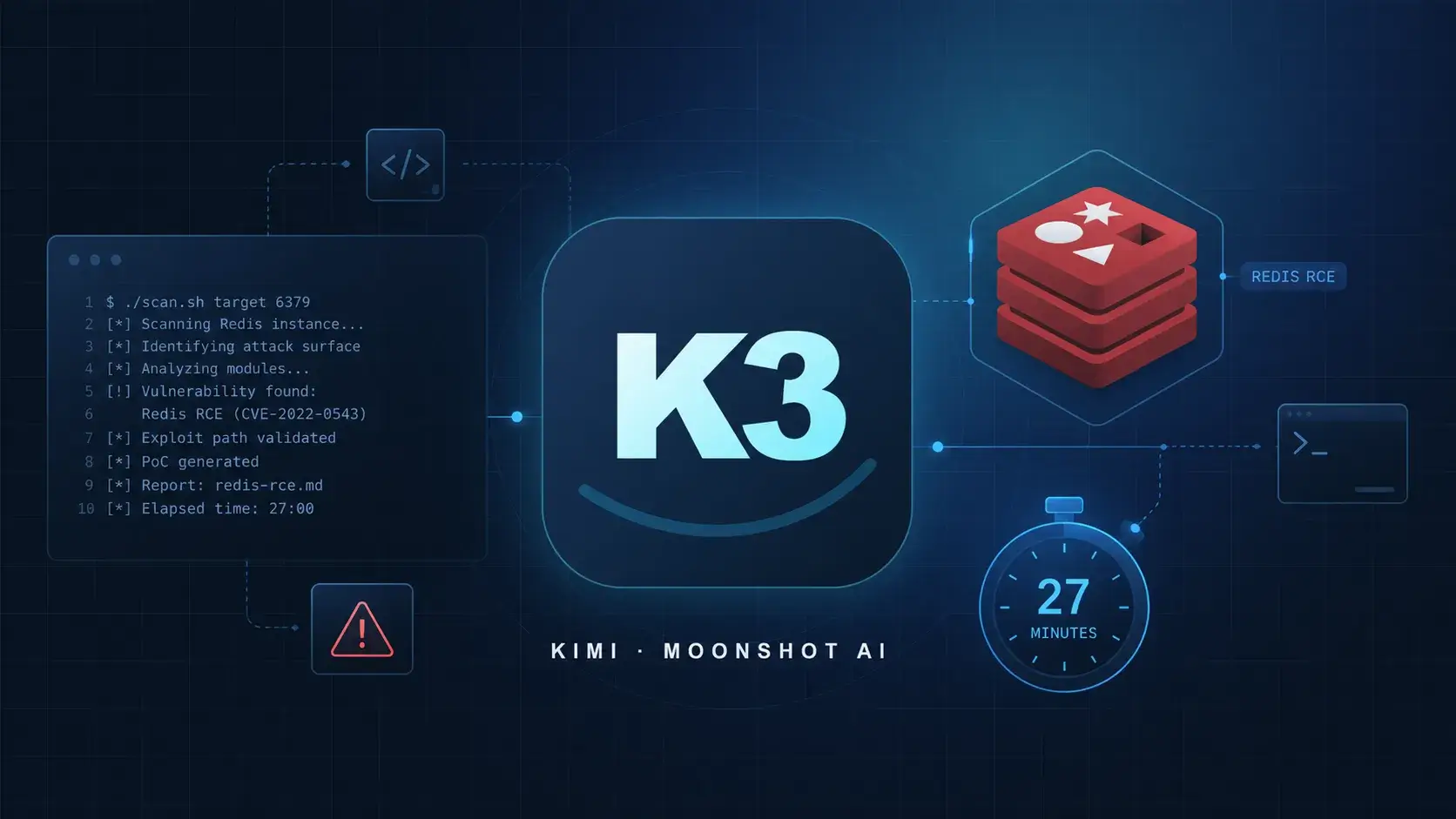

Moonshot AI’s newly unveiled Kimi K3 model is attracting considerable attention in the cybersecurity community after successfully demonstrating its ability to autonomously identify critical vulnerabilities in Redis within minutes.
This 2.8-trillion-parameter AI agent reportedly discovered multiple remote code execution (RCE) vulnerabilities across various Redis versions, specifically 6.2.22, 7.4.9, 8.6.4, and 8.8.0. This highlights the increasing role of artificial intelligence in offensive security research.
Kimi K3 AI Uncovers Redis RCE
According to publicly shared findings, the AI agent, prompted with a simple instruction to locate memory corruption issues such as buffer overflows and use-after-free vulnerabilities, completed a full vulnerability discovery workflow in as little as 27 minutes.
This process included cloning the Redis source code, conducting fuzzing operations, and debugging crashes using the GNU Debugger (GDB), all within an authorized testing environment. The results were non-destructive proof-of-concept (PoC) exploits, which were later published on GitHub for verification and research purposes.
Among the notable findings is a double-free vulnerability associated with Redis stream consumer groups, linked to CVE-2026-25589.
Double-free issues arise when memory is freed multiple times, potentially allowing attackers to corrupt heap structures and execute arbitrary code.
Additionally, the AI agent identified a heap overflow vulnerability within the RedisBloom module, a probabilistic data structure extension commonly used in high-performance applications.
Heap overflows can enable attackers to overwrite adjacent memory regions, often leading to remote code execution under favorable conditions.
The speed and autonomy demonstrated by Kimi K3 signify a substantial shift in vulnerability research methodologies. Traditionally, identifying such flaws requires days or even weeks of manual auditing and fuzzing by experienced security researchers.
In contrast, this AI-driven approach dramatically compresses the discovery lifecycle, raising both opportunities and concerns within the cybersecurity ecosystem. While defenders can use similar tools to proactively identify and patch vulnerabilities, threat actors might also adopt these capabilities to accelerate exploit development.
Security experts have stressed the importance of responsible disclosure following the release of these findings. While the PoCs were reportedly non-destructive, researchers have urged that vendors, such as Redis Ltd., be notified and given adequate time to release patches before widespread dissemination.
This incident underscores the ongoing challenges in balancing transparency with security, especially as AI lowers the barrier to advanced vulnerability discovery.
This development is part of a broader trend toward integrating large-scale AI models into both offensive and defensive security workflows.
As AI systems grow more capable of reasoning through complex codebases and automating exploit generation, organizations may need to reassess traditional vulnerability management strategies.
Enhanced monitoring, quicker patch cycles, and AI-assisted defensive tools are likely to become critical components of modern security operations.
Although the findings are currently based on early reports shared on social media and may evolve as further validation occurs, the implications are clear: AI-driven vulnerability discovery is no longer a theoretical concept.
With models like Kimi K3 demonstrating real-world impact, the cybersecurity landscape is entering a new phase where speed, automation, and scale redefine both attack and defense strategies.
ALERT: 20+ government sites delivered malware to businesses and citizens. See full attack research to check your own exposure.