
AWS has introduced “Continuum,” a new security capability designed to detect, validate, and remediate code vulnerabilities at machine speed, signaling a shift away from traditional telemetry-heavy security models toward automated, context-driven remediation.
Announced on June 17, 2026, in a gated preview, AWS Continuum leverages advanced AI models to address the growing volume of vulnerabilities generated by modern development environments and frontier AI systems.
AWS noted that conventional approaches, centered on collecting logs, querying datasets, and monitoring dashboards, are no longer sufficient to handle the exponential increase in vulnerability discovery driven by AI-powered analysis tools.
AWS Launches Continuum
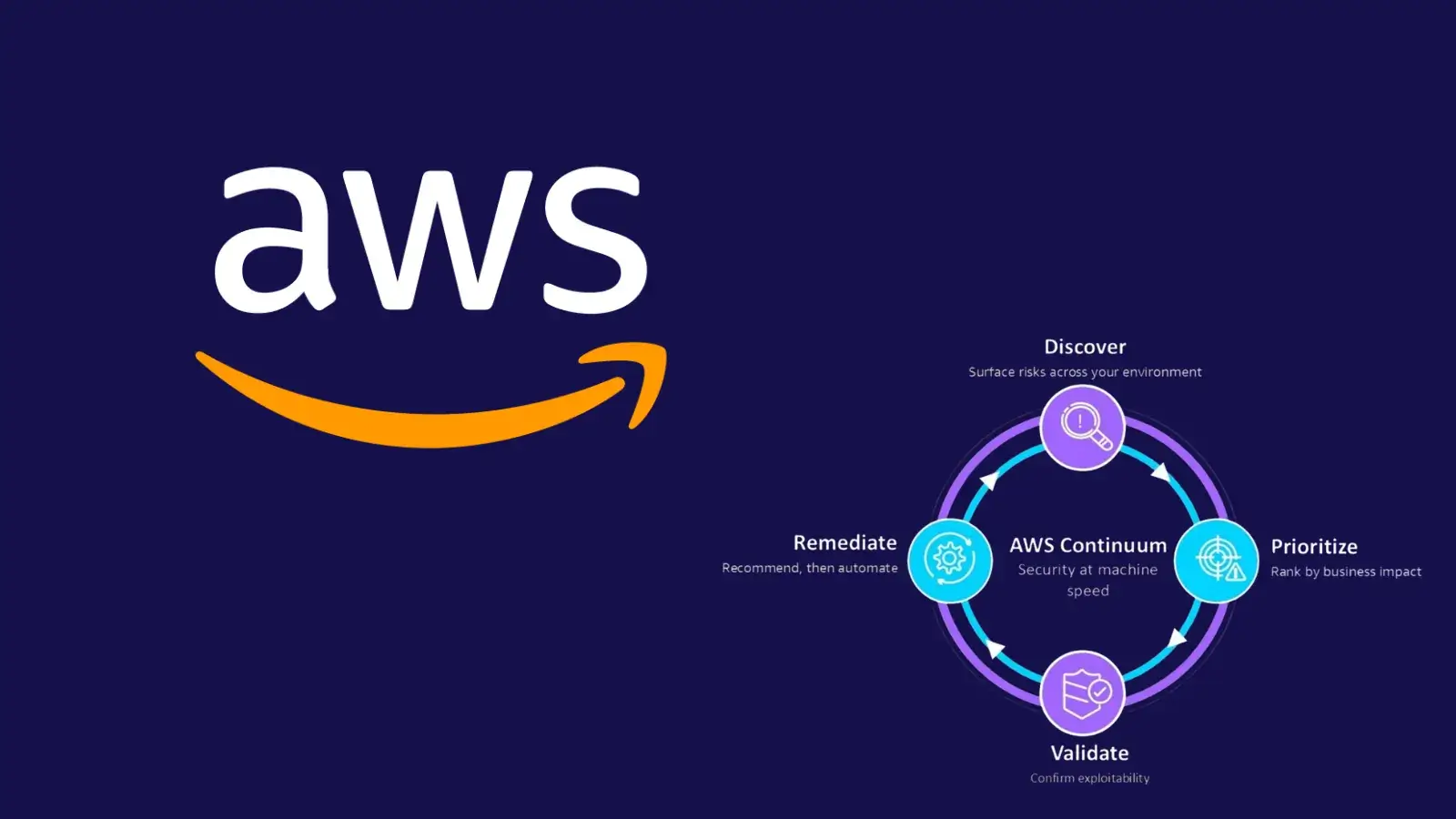
Continuum is built to operate across the full lifecycle of a vulnerability, integrating discovery, prioritization, validation, and remediation into a continuous loop.
Unlike static scanning tools, the platform reasons over both structured data, such as AWS infrastructure, permissions, and network topology, and unstructured organizational context, including internal documentation and business priorities.
This allows Continuum to assess not just whether a vulnerability exists, but whether it is exploitable in a real-world environment and what impact it may have on business operations.
The system introduces a model-agnostic architecture that enables it to use multiple frontier AI models depending on the task and to evolve as new models emerge.
AWS emphasized that this flexibility is critical as AI systems increasingly uncover complex attack paths and previously undetected vulnerabilities at scale, creating operational bottlenecks for security teams.
Continuum operates through four key phases. During discovery, it ingests existing vulnerability backlogs and performs independent scans to build a comprehensive risk inventory.
Core Capabilities
| Feature | Description |
|---|---|
| Continuum Discovery | Aggregates existing vulnerabilities and performs environment-wide scanning |
| Contextual Prioritization | Ranks vulnerabilities based on exploitability, exposure, and business impact |
| Exploit Validation | Generates sandboxed proof-of-concept exploits to eliminate false positives |
| Automated Remediation | Recommends and validates patches, configuration changes, and controls |
| Graduated Trust Model | Supports human-in-the-loop and fully automated enforcement modes |
| Threat Modeling | Generates STRIDE-based threat models from code and design artifacts |
| Model-Agnostic AI | Uses multiple AI models optimized for different security tasks |
In prioritization, it evaluates factors such as exploitability, production exposure, and business impact to rank findings. Validation focuses on reducing false positives by generating reproducible exploit scenarios in sandboxed environments.
Finally, mitigation and remediation involve recommending and validating fixes, including code patches, configuration updates, and compensating controls, while also providing blast radius analysis and rollback options.
A notable feature is its “graduated trust” model. Initially, Continuum operates in a human-in-the-loop mode, providing transparent reasoning for each recommendation. Over time, organizations can transition to automated enforcement, allowing the system to apply fixes based on predefined risk thresholds and policies.
In addition to code vulnerability management, AWS is integrating existing capabilities into the Continuum framework. These include penetration testing and code scanning via the AWS Security Agent, as well as a new threat modeling feature that automatically generates STRIDE-based models from application code or design documents. These components feed into the broader Continuum pipeline, enhancing detection and contextual analysis.
Follow us on Google News, LinkedIn, and X to Get Instant Updates and Set GBH as a Preferred Source in Google.