

In the South China Sea, Chinese threat actors have targeted wind turbine fleets and Australian government agencies as a means of extortion. A fake Australian media outlet impersonating an Australian news outlet is being used by these people to target select individuals.
It has been discovered that victims who received malicious JavaScript payloads via the ScanBox reconnaissance framework, ended up on the fraudulent site after receiving phishing emails containing enticing lures.
In this campaign, the target audience was people in the following industries and it ran from April to June of this year:-
- Australian Government agencies
- Australian news media organizations
- Global heavy industry manufacturers
- Wind turbines in the South China Sea
As reported by the PwC and Proofpoint security researchers, they evaluated that the campaign was intended to be used for cyberespionage purposes. There is a moderate level of confidence in attributing the activity to a group of threat actors from China, that is tracked as part of a group named APT40.
Illicit campaign
Several attacks originating from approx 6 Chinese threat actors have been observed by security analysts in the past which employed ScanBox as a component.
While there are several pieces of evidence indicating that the toolkit has been deployed at least since 2014, but there is still plenty of doubt to go around.

Here below we have mentioned all the 6 Chinese threat actors:-
- Red Sylvan (a.k.a. APT3, Gothic Panda)
- Red Apollo (a.k.a. APT10, Stone Panda)
- Red Phoenix (a.k.a. APT27, Emissary Panda)
- TA423 / Red Ladon (a.k.a. APT40, Leviathan, GADOLINIUM)
- Red Dev 16 (a.k.a. Evil Eye, Earth Empusa, Poison Carp)
- TA413 / White Dev 9 (a.k.a. LuckyCat)
Here, the targets were phished by the threat actors through Gmail and Outlook emails in multiple malicious waves.
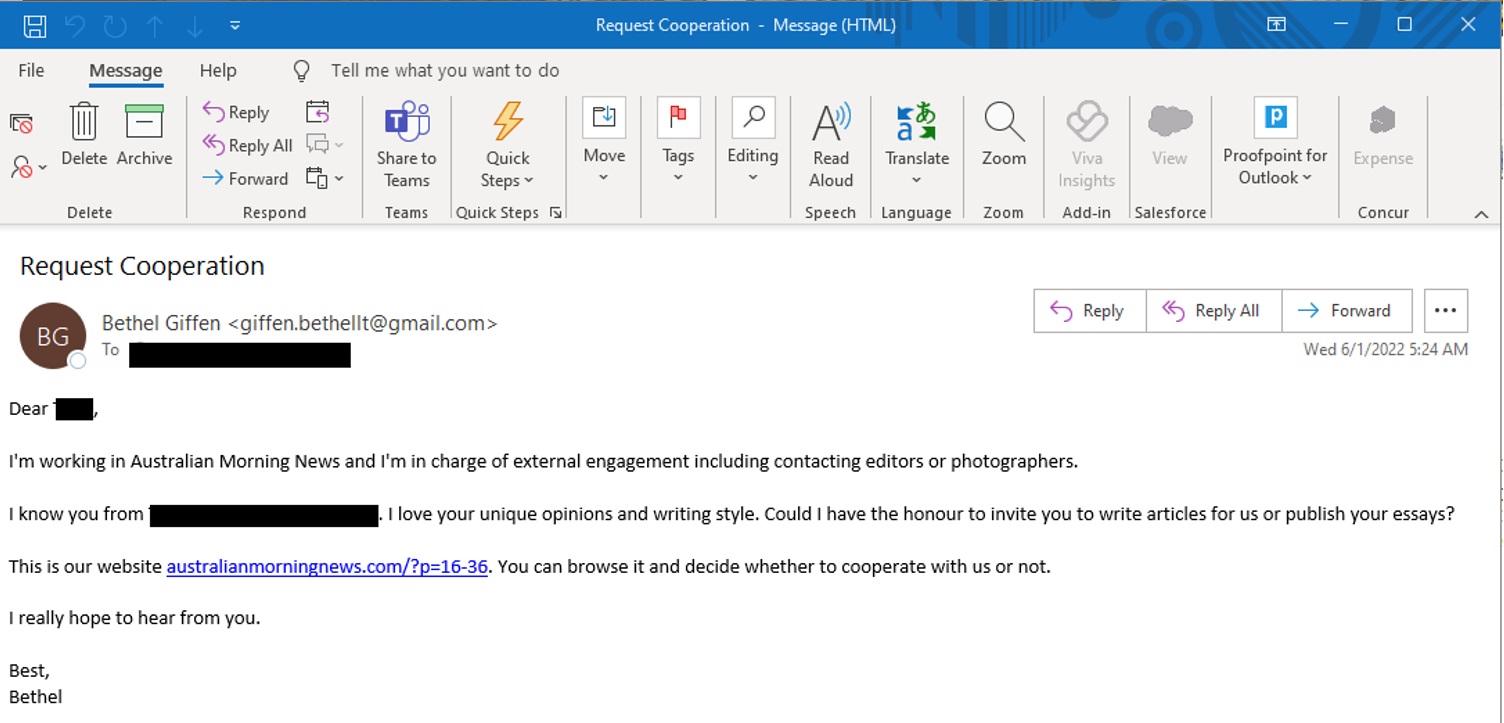
This email was sent by a person pretending to be an employee of an authentic news media outlet “Australian Morning News,” which in reality is a fake media outlet to include and push a link to a malicious website.

However, to make it more legit, several legitimate news portals were copied and pasted into the site in order to create content for the site.
Despite leading to the same web page and malicious payload in every case, the URLs included individually unique values for each target.
A copy of the ScanBox framework was served to visitors of the fake website via JavaScript execution and a staging module loading process through which they could run their own scans.
Modules
ScanBox framework is comprised of the following modules:-
- Keylogger
- Browser plugins
- Browser fingerprinting
- Peer connection
- Security check
As soon as the victim’s machine has been set up with the framework and the chosen plugins have been installed, the attack can begin. As a result, C2 communication is set up and the following information about the victim is sent over the system:-
- Profile data
- Technical details
- Useful information for reconnaissance
- Useful information for basic espionage
APT40 is a threat actor with a history of attacks that spans enough time for the US Department of Justice to indict members of APT40 in July 2021, based on that attack history.
Among the entities targeted by this threat actor is the energy exploration industry in the South China Sea, as well as defense and healthcare entities in Australia.
Secure Azure AD Conditional Access – Download Free White Paper







