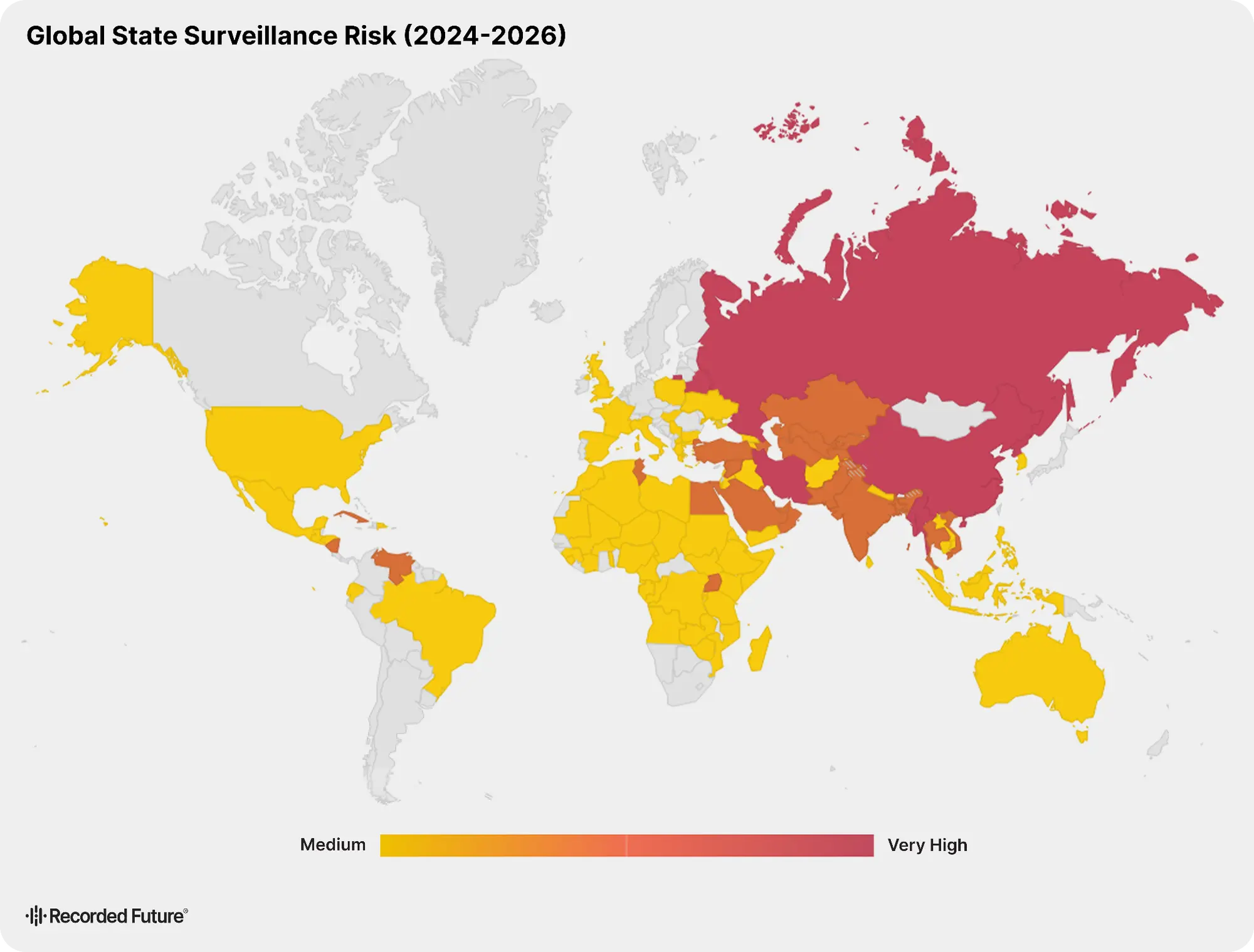
A new state-surveillance assessment finds that foreign travelers and business staff face high or very high digital risk in 31 countries, where governments increasingly use telecom interception, spyware, AI-enabled monitoring, and data aggregation with little meaningful oversight.
The concern is not just espionage in the classic sense; it is the routine conversion of travel, communications, and device data into a surveillance surface that can be exploited for intelligence collection, coercion, or theft.
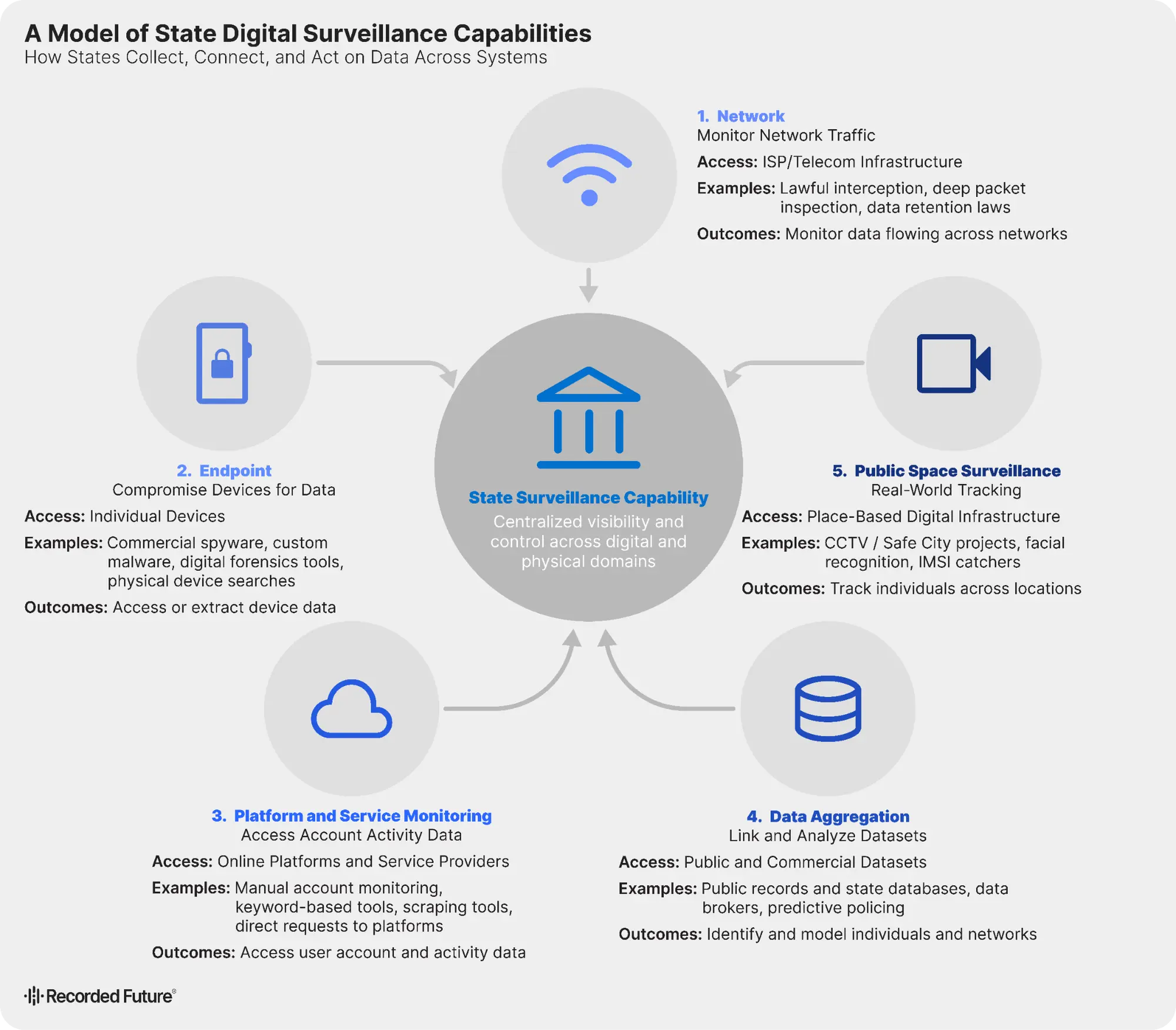
The report breaks state surveillance capability into five broad vectors: network interception, endpoint compromise, platform-level access, public-space surveillance, and data aggregation.
That matters because each vector exposes a different layer of enterprise risk, from metadata and content capture to device seizure, facial recognition, and linkage across passport, SIM, banking, and hotel records.
In practice, governments with direct control over telecom infrastructure or weak judicial constraints can monitor travelers without touching the device itself, undermining conventional mobile-security assumptions.
For corporations, the exposure is immediate and operational. Sensitive deal terms, source code, M&A discussions, strategic roadmaps, and executive communications can all be captured if employees carry ordinary corporate devices into high-risk jurisdictions.
Foreign Travelers and Businesses at Risk
According to Insikt, report also warns that surveillance can trigger downstream harm, including IP theft, reputational damage, targeted intelligence operations, physical intimidation, or detention, especially when foreign nationals are singled out under opaque legal regimes.
The strongest warning sign is not simply the presence of advanced tooling, but the absence of independent oversight, proportionality, and clear legal limits.
The assessment notes that governments may lawfully justify access to metadata, subscriber information, or public-platform data, yet still use those channels to build detailed behavioral profiles and suppress dissent.
It also highlights commercial spyware as a major accelerant, since off-the-shelf intrusion tools let states conduct highly targeted monitoring without building a full internal surveillance stack.
The broader trend is convergence: biometric databases, social-media monitoring, and AI-driven analytics are increasingly fused into national surveillance architectures.
That convergence lowers the barrier to identifying a traveler, mapping their contacts, and correlating movements across borders and services.
In several cases cited in the report, foreign visitors and business representatives were explicitly named as surveillance targets, which underscores that corporate mobility is now a cyber-risk issue, not only a travel-security issue.
The report is based on an evaluation of surveillance risk across 193 countries and uses Recorded Future’s Country Risk framework, with country-level State Surveillance Notes available to subscribers.
It also points to international privacy norms, including the UN position that surveillance must be lawful, necessary, and proportionate, with effective oversight.
For organizations, the practical response is to treat destination risk as part of travel planning, apply strict device compartmentalization, and assume that communications, location data, and platform access may be monitored in higher-risk states.
The larger message is clear: in the current threat environment, state surveillance is a cross-border enterprise risk vector, and the weakest legal regimes can be as dangerous as the most advanced tooling.
Follow us on Google News, LinkedIn, and X to Get Instant Updates and Set GBH as a Preferred Source in Google.