

The new ‘MosaicLoader’ malware, a password-stealing Windows malware is distributed through adverts for cracked software. The cybersecurity company Bitdefender warns as the malware installs cryptocurrency miners and delivers trojan malware and those behind it want to sell access to Windows PCs onto other cybercriminals.
MosaicLoader is delivered through paid ads in search results designed to entice users looking for cracked software to infect their devices.
Researchers say that “Once the malware affects a system, it creates a complex chain of processes and tries to download a variety of threats, from simple cookie stealers, crypto-currency miners to fully-fledged backdoors such as Glupteba”.
Glupteba is a type of malware that creates a backdoor onto infected systems, which can then be used to steal sensitive information, including usernames and passwords, as well as financial information.
“The attackers behind MosaicLoader created a piece of malware that can deliver any payload on the system, making it potentially profitable as a delivery service,” researchers at Bitdefender explained.
Bitdefender researchers observed the malware sprayer delivering Facebook cookie stealers, which exfiltrate login data, this allows cyberattackers to take over accounts, create posts that spread malware or those that cause reputational damage.
The malware spreads a variety of RATs for espionage purposes, which can log keystrokes, record audio from the microphone and images from the webcam, capture screenshots and so on.
Execution Flow Of MosaicLoader
- Mimicking file information that is similar to legitimate software
- Code obfuscation with small chunks and shuffled execution order
- Payload delivery mechanism infecting the victim with several malware strains
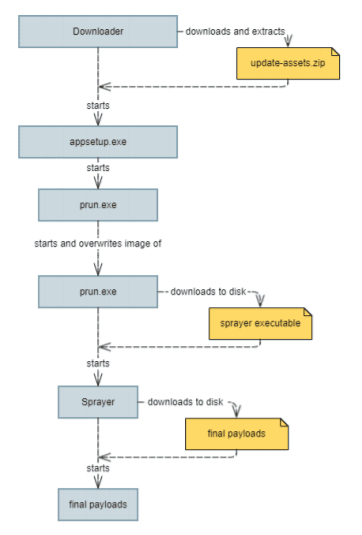
First Stage: MosaicLoader
The installation of a dropper begins, which imitates legitimate software: Researchers analyzed icons and “version information” that reflect those used for legitimate applications. Then the dropper contacts C2 and downloads the .zip file containing appsetup.exe, and prun.exe.
Second Stage: appsetup.exe
It is used to achieve persistence on the system. The appsetup.exe registers as a service called “pubgame-updater” to run once in a while, ensuring that even if the persistence registry key gets cleaned up, it adds it again.
Second Stage: prun.exe
The prun.exe uses mathematical operations with large numbers to obtain values required by the program. It employs a process-hollowing technique to inject code into a newly created process to communicate with the C2 to download the final stage: A malware sprayer.
Stage 3: Malware Sprayer
It downloads a list of malware from a list of URLs controlled by the attackers that host malware and execute them. Thus, it can deliver any malware on the system.
How to Defend against the Malware?
Researchers advise that users should not download and install applications from untrusted websites. Organizations should apply the IOCs to their EDR systems to ensure that employees working from home (who are at higher risk for downloading cracked software) are not impacted.
Users should never turn off their security solution when it blocks the installation of software downloaded from the internet, as attackers have become skillful at bundling legitimate apps with malware.
You can follow us on Linkedin, Twitter, Facebook for daily Cybersecurity and hacking news updates.







