

Minecraft is a sandbox video game developed by Mojang. The first version of Minecraft was released earlier in 2009, but the game remains incredibly popular to the present day. It is the best-selling video game of all time, with 200 million copies sold and 126 million monthly active users as of 2020.
Since July of this year, Kaspersky researchers have detected quite 20 apps on Google Play claiming to be modpacks for Minecraft, when their primary purpose is to display ads on smartphones and tablets in a particularly intrusive manner.
Fake Minecraft mods on Google Play
Most of the deceitful apps already been removed from Google Play. The five that remained were:
- Zone Modding Minecraft,
- Textures for Minecraft ACPE,
- Seeded for Minecraft ACPE,
- Mods for Minecraft ACPE,
- Darcy Minecraft Mod.
The most popular had quite 1 million installs. Even the least popular was downloaded 500 times, the report said.
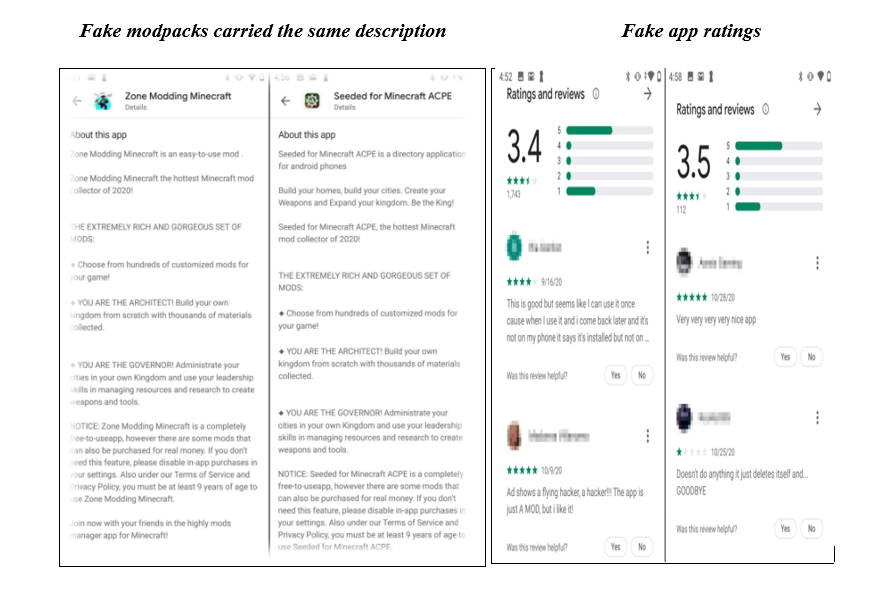
Although the apps have different publishers, two of the fake modpacks carried almost the same description. The app reviews are contradictory.
Average ratings hover around the 3-star mark, but overall, scores are highly polarized, mostly 5s and 1s (as shown in the screenshots below). This implies the real users are very unhappy.
In this case, the cybercriminals are targeting kids and teenagers, who may not pay attention to ratings and reviews before installing an app.
The malware creators can also attempt to get back the apps back within the store since the users have already got the apps installed on their smartphones.
Fake mods on the device
The irritated user closes the app, which promptly vanishes. “Because the ‘modpack’ seemed glitchy from the start, most users, especially kids and teens, won’t waste time looking for it.
Forgotten, the app still runs in the background, starts displaying ads. The sample examined automatically opened a browser window with ads every two minutes”, says the report.
The Apps can open Google Play and Facebook or play YouTube videos, counting on the C&C server’s orders. Regardless of the case, the stable stream of full-screen ads makes the phone almost unusable.
How to remove malicious Minecraft modpacks
The only way to defeat the problem is to get rid of the malicious app. After identifying the malicious app, in device settings (Settings → Apps and notifications → Show all apps) delete it from there.
Fortunately, the misbehaving modpacks get removed entirely with deletion and do not try to restore themselves.
Conclusion
It’s better to educate the youngsters about the potential dangers of apps, including ones on Google Play. Particularly, focus on poorly written descriptions and wildly varying ratings and reviews, and be sure to install a mobile antivirus utility on the device.
You can follow us on Linkedin, Twitter, Facebook for daily Cybersecurity, and hacking news updates.
Delete Now! – These 21 Apps With More Than 7 Million Downloads Contains Malware
Winnti APT Hacker Group Attacks Video Gaming Companies Using PipeMon Malware







