

A sophisticated supply-chain compromise has targeted users of EmEditor, a widely adopted text and code editor popular among developers worldwide.
Security researchers have identified a compromised installer capable of delivering multistage malware designed to steal credentials, exfiltrate data, and facilitate lateral movement within compromised networks.
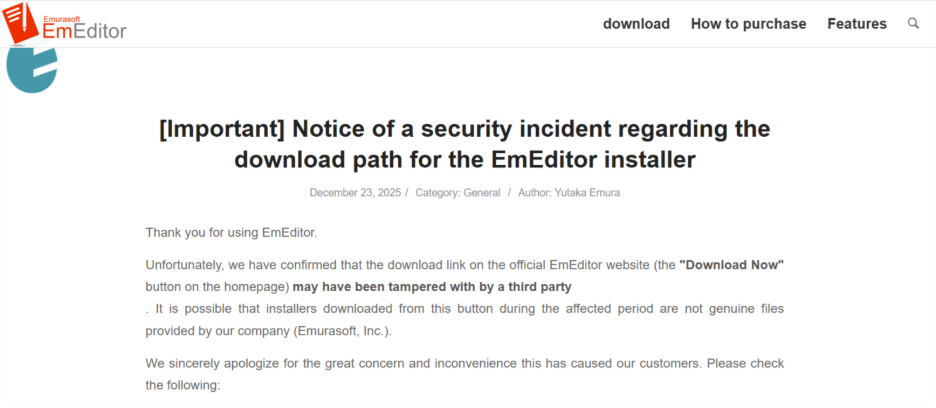
In late December 2025, Emurasoft, the U.S.-based developer of EmEditor, disclosed that its official download page had been compromised.
Attackers modified the software’s installer to distribute malicious payloads disguised as legitimate updates. The attack appears strategically timed to exploit year-end holiday periods when organizational security postures tend to weaken.
EmEditor’s strong reputation within Japanese developer communities suggests attackers may have deliberately targeted this specific user base or used the compromised download channel as a delivery mechanism for targeted intrusions.
However, the threat actor remains unidentified, though geofencing behavior indicates likely Russian or Commonwealth of Independent States (CIS) origin.
Technical Breakdown
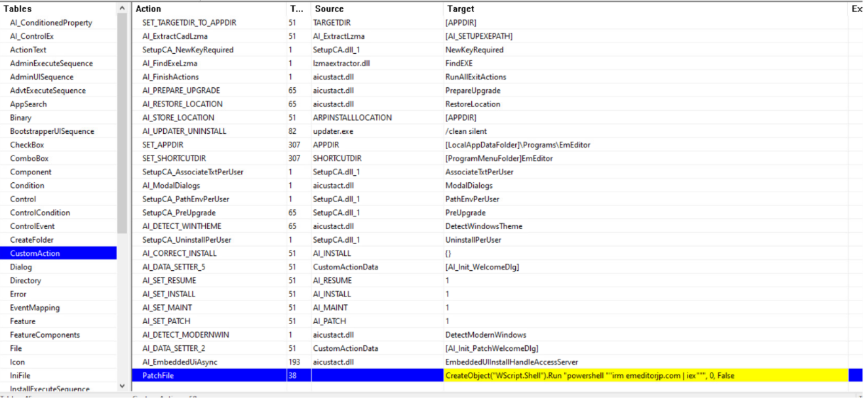
The compromised installer distributed as a modified Microsoft Installer (.MSI) file executes a malicious PowerShell command upon installation.
Research provides an analysis of a software supply chain compromise involving EmEditor, a text editor widely used by developer communities globally.
This command retrieves first-stage code from a spoofed legitimate domain (EmEditorjp[.]com), which subsequently connects to two additional URLs to download the primary payload.
The malware employs sophisticated obfuscation techniques using PowerShell string manipulation methods including Insert, Remove, Replace, Substring, and Trim functions. This obfuscation persists across successive payload stages, complicating detection and analysis.
The attack deploys two distinct payloads with complementary functions. The first payload serves as the primary antisecurity mechanism, featuring:
- Disabling PowerShell Event Tracing for Windows (ETW) to evade detection.
- Credential theft through Windows Credential Manager access.
- Process detection to identify installed security software.
- Anti-virtualization evasion techniques.
- Screenshot capture for reconnaissance.
The second payload focuses on system reconnaissance and persistence:
- System fingerprinting and hardware enumeration.
- Geofencing to prevent execution in specific countries (Armenia, Belarus, Georgia, Kazakhstan, Kyrgyzstan).
- Command-and-control communication and data exfiltration.
- Registry scanning to detect security applications.
All collected information is transmitted to a C&C server at cachingdrive[.]com, with a consistent campaign identifier “2daef8cd” embedded in communications, potentially indicating a specific threat campaign.
Implications for Organizations
This incident fundamentally challenges security assumptions about trusted software channels. Traditional beliefs that official vendor installers present lower risk than exploit-driven attacks have been effectively disproven.
Organizations cannot afford complacency regarding software sourced from official vendors or download pages.
Companies face significant risk from third-party software distributed through public channels, particularly Windows-based applications.
Early detection becomes critical, as the malware’s deferred execution after installation enables bypass of initial defensive mechanisms and extended dwell time within networks.
Organizations should validate installer integrity by verifying digital signatures before execution, even from official sources. PowerShell execution requires strict governance with robust logging to detect obfuscated scripts and network-enabled commands.
Endpoint telemetry preservation is essential organizations must actively monitor for attempts to turn off logging mechanisms. Implementing least-privilege principles for credentials and networks limits lateral movement opportunities following initial compromise.
Follow us on Google News, LinkedIn, and X to Get Instant Updates and Set GBH as a Preferred Source in Google.







