

As opposed to web shells, malicious extensions for the IIS web server have a lower detection rate, which means attackers are increasingly using them to backdoor unpatched Exchange servers.
Since they can be hidden deep within a compromised server, and are often very difficult to detect. As they are installed in the same location as legitimate modules and use the same structure, attackers can provide themselves with the perfect and durable persistence mechanism that they need.
Since they use the same structure as legitimate modules in order to achieve the same effect as legitimate modules. The actual mechanism used to create a backdoor is usually quite minimal and the logic is not regarded as malicious in most cases.
Continued Access and built-in Capability
It is rare that attackers will use unpatched security flaws in an app that is hosted to inject such malicious extensions into a server after successfully compromising it.
These types of attacks are usually deployed after the initial payload for the attack is deployed, usually a web shell. Later on, the IIS module is deployed on the compromised server so that it can be accessed more stealthily and persistently.
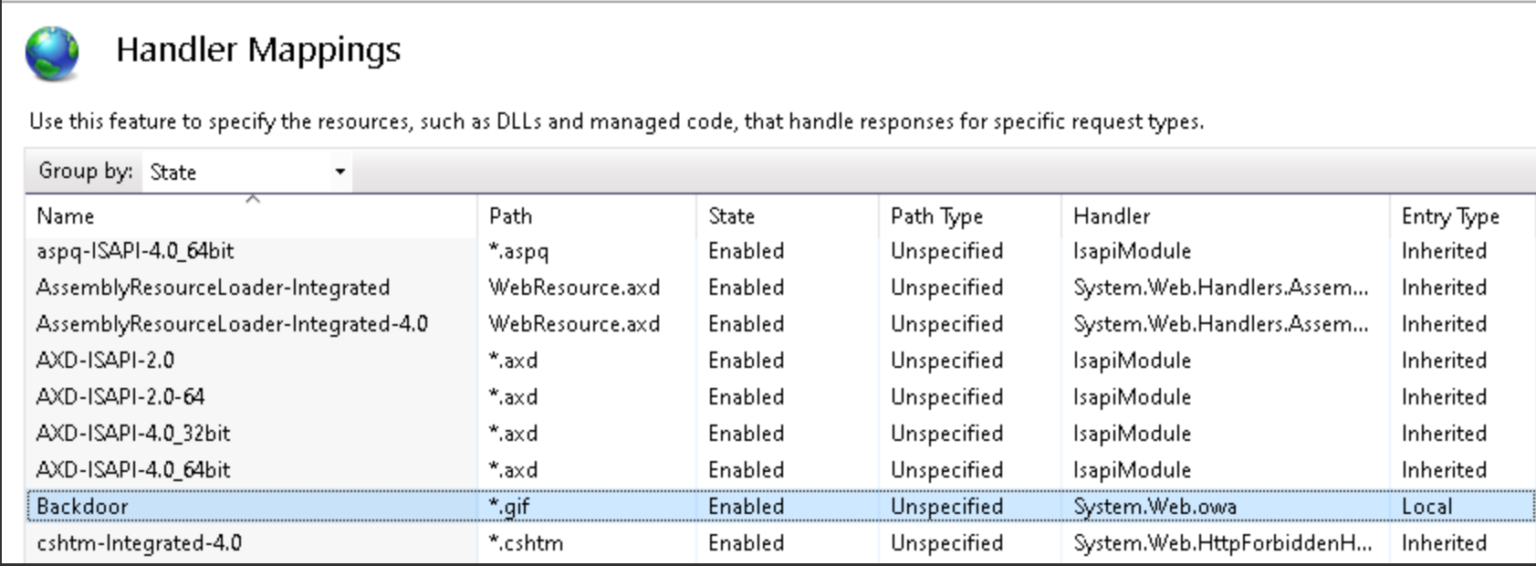
Previously, Microsoft experienced the installation of custom IIS backdoors after hackers exploited the following products:-
- ZOHO ManageEngine ADSelfService Plus
- SolarWinds Orion
There are several things that can be harvested by malicious IIS modules once they have been deployed, and here they are listed below:-
- From the memory of the system, credentials are retrieved
- Data collection from infected devices and the victims’ network
- Payloads are delivered at a higher rate
Types of IIS Backdoors
Here below we have mentioned all the types of IIS backdoors:-
- Web shell-based variants
- Open-source variants
- IIS handlers
- Credential stealers
As a result of Kaspersky’s recent analysis of IIS extensions delivered onto Microsoft Exchange servers, it has been observed that malware performs the following actions:-
- Execute commands
- Steal credentials remotely
It has been at least since March 2021 that a similar piece of IIS malware has been detected in the wild, and this malware is referred to as SessionManager.
Recommendations
It is recommended that you consider the following mitigations in order to protect your system against attacks that use malicious IIS modules:-
- Make sure to keep Exchange servers up to date
- It is important to keep anti-malware and security solutions enabled at all times
- Make sure that roles and groups that are sensitive are reviewed
- IIS virtual directories can be restricted in order to prevent unauthorized access
- Alerts should be prioritized based on their importance
- Ensure that the configuration files and bin folders are in order







