Sunday, October 18, 2026

Accidental Syntax Error Leads to Kill The Cryptomining botnet Malware “KmsdBot”

It turns out that Akamai’s team of researchers accidentally killed a newly discovered cryptocurrency mining botnet known as KmsdBot during the investigation.

Due to a syntax error, the botnet was unable to send commands any longer, and as a result, it was destroyed. 

KmsdBot and its C2 functionality

KMSDBot is a cryptomining botnet that uses weak credentials and SSH to infect its victims with a crypto-mining malware and then deploy the miner. Apart from this, the KmsdBot is equipped with command-and-control capabilities.

After one of Akamai’s honeypots was contaminated with the botnet, the Akamai team assessed the situation and reported on it.

A variety of microarchitectures were used in the botnet’s deployment to target Linux and Windows devices, and on these devices, it deploy the following components:-

  • Miners
  • DDoS bot army

It primarily targets firms that are involved in gaming and technology, as well as manufacturers of luxury vehicles.

It is imperative to note that the ability to gain C2 is arguably the most lethal aspect of any malicious entity, and KmsdBot is the one that has the C2 functionalities. 

Event Information

Researchers from Akamai reported that the operating mechanism of the botnet in a controlled environment, they sent commands that mistakenly neutralized the malware.

A bot stopped sending commands as soon as it received a command that was improperly formatted. A possible reason for this could be that the program was not built with an internal error-checking feature that would check the commands coming into its source code for errors before they were executed. 
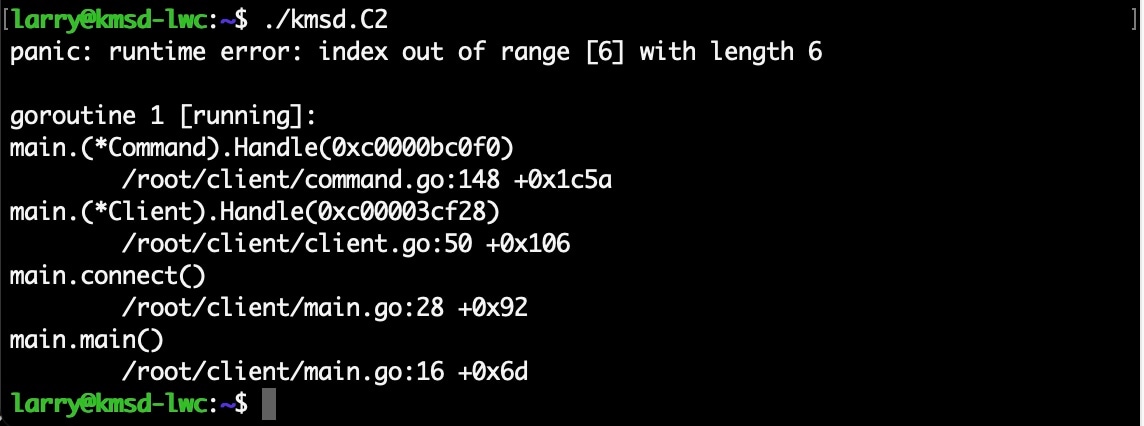
The bot crashed because the wrong number of arguments were supplied (Credits: Akamai)

On the infected devices, the Go binary stop interacting with its C2 server, as a result when the instruction is given to the target website without a space between the port number.

A persistence mechanism is not present in the botnet, due to its lack of functionality. In short, in the event of detection, the operators of the botnet will need to re-infect the target device.

As a result, this can be seen as an example of how technology is capricious, and how even the person who is exploiting it may find themselves exploited, too. 

Secure Web Gateway – Web Filter Rules, Activity Tracking & Malware Protection – Download Free E-Book

Balaji
Balaji
BALAJI is an Ex-Security Researcher (Threat Research Labs) at Comodo Cybersecurity. Editor-in-Chief & Co-Founder - Cyber Security News & GBHackers On Security.

Hot this week

How To Access Dark Web Anonymously and know its Secretive and Mysterious Activities

What is Deep Web The deep web, invisible web, or...

How to Build and Run a Security Operations Center (SOC Guide) – 2023

Today’s Cyber security operations center (CSOC) should have everything...

Russian Hackers Bypass EDR to Deliver a Weaponized TeamViewer Component

TeamViewer's popularity and remote access capabilities make it an...

Web Server Penetration Testing Checklist – 2026

Web server pentesting is performed under three significant categories: identity,...

ATM Penetration Testing – Advanced Testing Methods to Find The Vulnerabilities

ATM Penetration testing, Hackers have found different approaches to...

Hackers Use ConnectWise SkyKick Credentials to Access Microsoft 365, Halting Cloud Backups

Attackers abused compromised ConnectWise Cloud Backup credentials to access...

Anthropic’s Claude AI Uncovers Origins of NSA-Provided Cryptographic Keys After 25 Years

Anthropic says an internal Claude research model reconstructed how...

OpenBSD Kernel Flaw Dating Back 37 Years Enables Local Privilege Escalation to Root

A newly disclosed OpenBSD kernel exploitation chain combines a...

GhostAction Hackers Hide Credential-Stealing Malware in Fake Font Files Across 94 GitHub Repositories

GhostAction attackers have expanded their GitHub credential theft campaign...

SideCopy Hackers Target Indian Organizations With ReverseRAT Malware to Steal Data

Indian authorities have warned that SideCopy hackers are targeting...

New GhostBat Android Malware Targets 60 Banking and UPI Apps to Steal PINs

A new GhostBat RAT variant targets 60 Android financial...

New ROMULUS Malware Platform Uses Six Servers to Deliver Multiple Malicious Payloads

ROMULUS, a shared ClickFix delivery platform operating across six...

Related Articles

Recent News


